Aug 13,2026
Top 10 Mobile Protection Solutions Companies for Retailers in 2026
You lost your biggest store client last month. A shipment of chargers came three weeks late, and half of them broke within days. Your supplier disappeared when you asked for a refund. This happens more often than you think when buying phone accessories in bulk.
Is saving 10% on each item worth risking your brand's good name? Most buyers say no, yet many still skip proper checks. This guide gives you a 4-step plan to lower risk when buying in bulk. You will learn to set your needs, find suppliers, test samples, and manage partnerships.
A dependable supplier becomes a valuable partner. Building trust through careful checks protects your profits and your reputation. A reliable supplier grows with your business, turning one-time orders into long-term success.
Before you start looking for suppliers, know what products you need and how much you can spend.
Use directories, trade shows, and referrals to find possible suppliers.
Check certifications in official databases, not just PDFs.
Test product samples and place small test orders to make sure the products are good quality.
Build trust by talking clearly, tracking key performance indicators (KPIs), and paying on time.
Before you look for suppliers, be clear about what you need. This step saves time and helps you avoid expensive mistakes. You must know exactly what products you want and how much you can spend.
Phone accessories include many types. You probably need cases, screen protectors, chargers, cables, and audio accessories. Each type has its own standards. A basic requirement is that they work with big brands like Apple and Samsung.
The European market has strict new rules. Starting December 28, 2024, all phone accessories like phones, tablets, and headphones sold in the EU must have USB-C ports. This rule makes connectors more standard. You must make sure your chargers and cables follow this rule. Qi2 wireless charging certification also sets a higher quality standard for certified products. These products offer better thermal performance and compatibility.
Look for suppliers that give a warranty. A good warranty shows they believe in their product quality. Also look for certifications like Apple MFi, SGS, or TÜV. These marks show the products are safe and durable. For cases, check for drop protection and anti-yellowing technology. For screen protectors, check for scratch resistance and clear view. High-quality materials use hybrid polymers to protect against impact and reinforced tempered glass for strength.
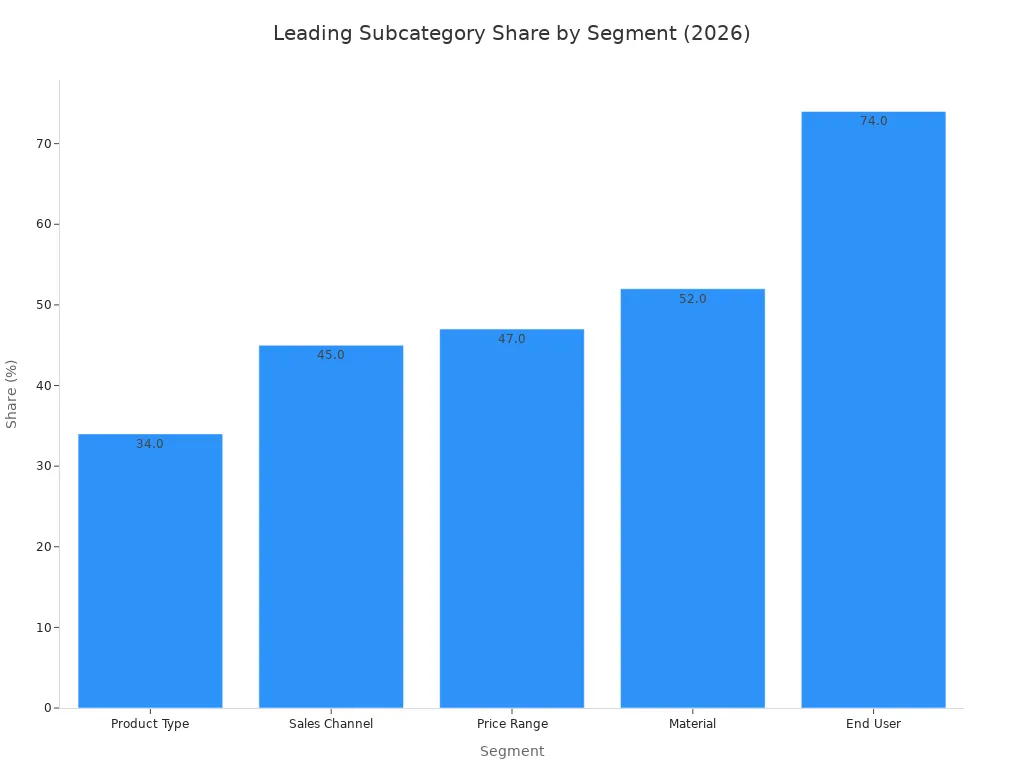
Market data shows clear trends. In 2026, protective cases and covers make up 34.0% of demand. Mid-range accessories account for 47.0% of sales. Plastic-based products have 52.0% of material demand. Individual buyers drive 74.0% of purchases. Match your product choices to these trends. Focus on the mid-range segment where most buyers spend their money.
How much you buy affects the cost. Ordering larger amounts lowers the price per item because of economies of scale. Think about buying in bulk to get better wholesale prices. But find the right balance between how much you buy and your budget. Order too little and you pay more per item. Order too much and you might have unsold stock.
Your budget decides which product models you can offer. The newest models have high prices. If you have a limited budget, choose models that give good performance at lower cost. Think about which features matter most to your customers. For example, focus on battery life for travel accessories or camera quality for photography gear. These choices guide your first bulk orders.
Market demand and resale value also matter. Do research using sales trends, surveys, and industry reports. Newer models like the iPhone 14 Pro keep higher resale value. Mix up your inventory by offering new and older models, different storage sizes, and color options. This approach lowers risk and increases profits. A balanced inventory helps you serve different customer groups.
Once you know what you need, you can start looking. Finding the right supplier takes time, but it is worth the effort. You want a supplier you can trust to deliver good products on time. This step has two parts: finding possible suppliers and checking if they are telling the truth.
Start with online wholesale sites that check their sellers first. Syncee and TVCMALL keep lists of suppliers they have reviewed. These sites check basic details before they add a company. You still need to do your own checks, but these sites save you time. They also offer buyer protection programs that add extra safety.
Trade shows give you a different benefit. You can see products in person, touch the materials, and test how strong they are. Big shows like Canton Fair in China and CES in Las Vegas have hundreds of accessory makers. Walk around, grab samples, and ask direct questions. You can spot quality problems that photos hide. You can also see how professional a supplier is by how they set up their booth and answer your questions.
Referrals work well too. Ask other store owners in your network about their suppliers. A suggestion from someone who has placed many orders carries real weight. They can tell you about delivery times, how well the supplier communicates, and how they fix problems. These insights come from real experience, not from ads.
Use all three methods together. Use directories to make a long list, trade shows to shorten it, and referrals to confirm your top picks. This way, you get a strong group of candidates for the next step.
Now you check if each candidate is telling the truth. Certifications are your first filter. They show that a supplier meets known standards. The table below shows key certifications you should look for.
Certification | Applicability | Verification Method |
|---|---|---|
FCC Part 15 | Wireless devices | Public FCC ID lookup (fccid.io) |
UL 62368-1 | Power adapters | UL's Online Certifications Directory |
California Prop 65 | Labeling requirements | Third-party dated test reports |
UN38.3 | Battery-integrated accessories (power banks, earbuds) | Mandatory transport certification |
ISO 9001:2015 | Manufacturing quality management | Listed by verified manufacturers |
Check each certificate yourself. Do not accept a photo or a PDF copy. Use the official databases listed above. For example, you can search the FCC ID database to confirm a wireless charger's approval. You can verify an SGS certificate through their Certified Client Directory. Search by company name or certificate number. You can also check their Certified Components & Products Directory for specific items. If your supplier is in China, use the Audited Supplier Verification database to review audit results by report number or supplier name.
Look beyond certifications. Check the supplier's history. A strong supplier holds multiple certifications and has a proven record. For example, one supplier might hold SGS/TUV certification, ISO 9001:2015, and over 180 patents. Another might run a 12,000 square meter factory with 10 production lines and 300 employees. Both examples show serious operations. Compare these details against your needs.
Ask about warranty policies. A supplier who offers a solid warranty shows they believe in their products. This protection matters when you buy in bulk. You need a partner who stands behind their work.
Building trust takes time. You build it through checking, not guessing. Check every claim, ask for documents, and confirm through official channels. This careful work separates trustworthy wholesale partners from risky ones. Your goal is to find a partner who delivers steady quality at fair wholesale prices. The effort you put in now prevents costly problems later.
Remember that wholesale sourcing is a relationship, not a one-time deal. You want a partner who grows with your business. Take the time to check credentials fully. Your brand's reputation depends on the products you sell. A dependable supplier protects that reputation every day.

You found several promising suppliers. Now you must verify their claims before committing your money. This phase separates professional buyers from amateurs. Testing samples and negotiating clear terms protects your investment and builds a foundation for a dependable supplier relationship.
Order samples from your top three candidates. Do not skip this step, no matter how impressive their website looks. Physical testing reveals what photos hide. You need to verify that the products match the specifications you discussed.
Start with functional testing for chargers. Check output voltage and current under load. Verify fast charging protocol compatibility with popular phone brands. Test overheat protection by running each unit at maximum output for a sustained period. For cables, check charging speed and data transfer capability. Bend each cable repeatedly to test connector durability and flexibility.
Follow a structured sampling plan based on your order size. For orders of 100-500 pieces, perform random inspection. For 500-2000 pieces, increase your sampling rate. For orders above 2000 pieces, conduct batch quality inspection. Record every result, including product model, quantity, production batch, test outcomes, defective count, and inspector name. This documentation becomes your baseline for future orders.
Look for proprietary technologies that indicate serious engineering. Some suppliers invest heavily in research and development. For example, X·ONE uses DNA Guard technology for drop protection, certified by TUV and SGS for falls up to 20 feet. Their EnduraClear anti-yellowing treatment blocks UV and chemical damage, keeping transparent cases clear for up to 12 months longer than untreated materials. These innovations show a commitment to quality assurance that generic suppliers cannot match.
Technology | Core Function | Performance Metric |
|---|---|---|
EnduraClear™ | Anti-yellowing | Keeps cases clear up to 12 months longer |
DNA Guard™ | Drop protection | Survives 20ft drops |
Impact Fusion™ | Screen impact protection | 7× protection vs unprotected |
Optic Defense™ | Blue light filtering | Blocks up to 90% blue light |
DropGuard Clear is engineered with DNA Guard™ Technology, rigorously tested and certified by TUV for 10ft drops, and features EnduraClear™ Technology for ultra yellow-resistance, ensuring the case stays clear for a longer period.
Before placing a full bulk order, run a pilot order. Order a small quantity, perhaps a few dozen units. Sell them to your customers and gather feedback. Monitor return rates and complaints. A pilot run reveals real-world performance issues that lab testing misses. This step costs little compared to a failed large shipment.
After testing, compare quotes from your shortlisted suppliers. Look beyond the unit price. Calculate total landed cost, including shipping, customs duties, and insurance. A supplier with slightly higher wholesale prices might deliver better value if their products last longer and generate fewer returns.
Verify certification authenticity before negotiating. Cross-check UL File Numbers on UL's online database. Do not accept factory-provided PDFs alone. Request dated photos or videos of the production line, aging room, and test stations. Order three sample units with unique serial prefixes. Verify that firmware versions and component lot codes match factory records.
Watch for red flags during negotiation. A supplier without a published ISO 9001 certificate raises concerns. Refusal to share a basic bill of materials signals hidden problems. Claims of certification without naming the issuing body deserve suspicion. For example, a simple "CE" mark differs significantly from TÜV Rheinland CE certification.
Evaluate key specifications during your comparison. Check output stability under load, aiming for voltage ripple below ±50mV. Review the thermal derating curve to understand performance at high temperatures. Confirm safety isolation rating of at least 4kV AC. Verify protocol compatibility depth through USB-IF compliance reports.
Negotiate payment terms that protect both parties. Avoid paying the full amount upfront. Standard terms often include a deposit and the balance before shipment. Some suppliers offer better terms after you establish a track record. Discuss warranty coverage and clear return policies before signing. A dependable supplier stands behind their products with a solid warranty. This protection matters when you buy in bulk.
Build trust through transparent communication during this phase. Ask direct questions about production timelines and quality control processes. A supplier who answers clearly and provides documentation earns your confidence. One who deflects or delays signals future problems. Your careful evaluation now prevents costly mistakes later. The right partner offers fair mobile phone accessories pricing without compromising quality.
Your work does not end when the first shipment arrives. A dependable supplier relationship requires ongoing attention. You must build systems that keep both sides accountable and prepared for problems. This phase turns a single transaction into a lasting partnership.
Set a regular communication rhythm from day one. Schedule weekly tactical updates for critical suppliers and monthly strategic reviews. Use overlapping work hours to bridge time zone gaps. Predictability beats urgency. When both sides know when they will talk, small issues rarely become emergencies.
Make documentation your primary language. Use version-controlled purchase orders, technical specification sheets, and signed approvals. Every change replaces the previous version. Nothing exists in parallel. This practice eliminates confusion about what you ordered and what the supplier must deliver.
Define clear key performance indicators to measure your supplier's performance. Track on-time delivery rate, defect rate, and response time. For wholesale accounts, an acceptable on-time delivery rate is high, and retailers often require near-perfect rates to avoid chargebacks. Your defect rate should be very low for quality products. Response time measures how quickly the supplier addresses your inquiries and resolves issues.
Create visual standards for quality expectations. Use annotated photos and diagrams to show acceptable versus unacceptable results. Visuals remove interpretation and turn subjective opinions into objective references. This approach works especially well for mobile phone accessories where finish and fit matter greatly.
Conduct annual supplier scorecards using your KPIs. Review performance regularly to assess capability and address challenges collaboratively. Recognize good performance through supplier awards programs. These actions reinforce positive behaviors and encourage continuous improvement.
Pay your supplier on time. Timely payments demonstrate respect and build trust. A supplier who trusts you will communicate problems earlier and more honestly. They will also prioritize your orders during busy periods. This trust becomes a competitive advantage for your business.
Develop contingency plans for critical risks. Common threats include material shortages, natural disasters, and geopolitical disruptions. Metals used in consumer electronics rely on labor-intensive mining processes. Worker strikes or floods can slow the entire supply chain. Inflation drives up fuel, labor, and raw material costs. Create backup plans for your key products and review them every six months.
Maintain open dialogue with your supplier. Foster an environment where they feel comfortable sharing challenges. Be open to their feedback and advice. They may spot market trends or production improvements you miss. A reliable supplier who offers a solid warranty and stands behind their products becomes a strategic asset. This partnership ensures a steady flow of inventory and inventory that is always in stock for your customers. Your wholesale sourcing strategy depends on this relationship. The effort you invest in managing it pays returns through consistent quality and dependable delivery for years to come.
You now have a clear path: define your needs, source candidates, test samples, and manage the partnership. Each phase builds on the last. Skipping any step exposes your brand to unnecessary risk.
A dependable supplier is a strategic asset, not a cost center. They deliver consistent quality, honor their warranty, and communicate openly. This trust protects your reputation and your margins. You might pay slightly higher wholesale prices, but you save on returns, delays, and lost customers.
Start with Phase 1 today. You do not need a purchase order ready. Simply list your product requirements and budget range. This preparation positions you for success when the right opportunity appears.
Download our supplier scorecard template to evaluate candidates systematically. Or contact us for a free consultation on your mobile phone accessories sourcing strategy.
Most suppliers set minimum order quantities, and some factories accept smaller pilot orders. Ask each supplier directly. Compare their minimums against your budget and storage capacity. A lower minimum lets you test products before committing to larger volumes.
Check official databases instead of accepting PDF copies. Search the FCC ID database for wireless devices. Use UL's Online Certifications Directory for power adapters. Verify SGS certificates through their Certified Client Directory. Cross-reference every claim with the issuing body's records before placing orders.
Document everything immediately. Photograph damaged items and record batch numbers. Contact your supplier promptly with evidence. Review your warranty agreement for return procedures. A dependable supplier replaces defective units or issues credit. Track your defect rate against the agreed threshold.
Yes. Start with standard terms of a deposit and balance before shipment. After several successful orders, request more favorable payment terms, such as net terms. Suppliers who trust you may offer extended payment windows. Consistent on-time payments strengthen your position. Always get revised terms in writing before accepting them.
Join X.ONE to access our best-selling original product,and leverage our end to end technical and marketing support to unlock new growth opportunities for your business.
 Material Support
 Training Support
 Marketing Support
 Exhibition Support
 Technical Support
 After Sales Support