 繁体中文
 Italian
 Spanish
 Thai
 Turkish
 Japanese
 Portuguese
 Russian
 French
 German
 Polish
 Arabic
Aug 19,2026
Top Experienced Companies Providing Mobile Protection Products Worldwide
By 2026, you can't treat premium phone accessories as something you deal with later. Premium phone accessories now affect how people see your brand, how well devices are protected, and how happy your employees are. The numbers are huge. The global mobile phone accessories market reached $287.49 billion in 2026, which is a 6.4% increase from the year before. The danger is just as real. A bad supplier can send you fake products or cause problems at customs. This costs you money and hurts your reputation. So how do you find a partner who gives you real certifications and dependable shipping when you buy mobile accessories wholesale?
Look at each certificate before you buy. Real ones have valid ID numbers and lab reports.
A low price for one item often hides high costs over time. Cheap products break more often and need to be replaced.
Choose a supplier who gives clear Incoterms and written warranties. This keeps your money and quality safe.
Top-quality accessories are made with tough materials, like GaN chargers and anti-yellow coatings. These features make them last longer.

Premium means more than just a nice look. For corporate buying, premium phone accessories must handle daily wear, charge devices safely, and look professional when a client holds them. You should look for durable materials for protective cases and screen protectors, and drop-test standards for rugged protection. High-quality audio components keep earbuds and speakers sounding new. These features set serious products apart from generic ones.
Material science drives real performance. GaN (gallium nitride) technology lets chargers run smaller, cooler, and at higher power. USB-C PD supports fast charging and data transfer. Magnetic power banks and MFi-compatible cables complete a premium kit. You should also check certifications before you place any mobile accessories wholesale order.
Certification | Purpose |
|---|---|
CE | EU safety compliance |
RoHS | Restricts hazardous substances |
FCC | US radio compliance |
UL | Safety listing for chargers |
MFi | Apple compatibility |
Qi | Wireless charging interoperability |
Request product test reports and certificates (CE, RoHS, FCC, UL as applicable). Ask for third-party lab reports showing thermal safety results. Check ISO-9001 process controls.
Premium also covers how the product shows up. Steady branding and retail-grade packaging turn a useful item into a gift worth keeping. Magnetic lid boxes create a memorable unboxing moment. That first impression shapes how recipients judge your company. Generic packaging makes even good gifts feel plain. Custom packaging shows care and professionalism.
X·ONE shows what this looks like in real life. The brand holds over 180 patents and has sold more than 100 million units worldwide. Corporate buyers who want high-quality products across a wide range of wholesale phone accessories can study this model. Whether you source charging accessories wholesale or protective cases, quality must hold up at every touchpoint.
The right partner helps your company's program run well. The wrong one causes many problems. You need a step-by-step method to tell real suppliers from bad ones.
Several platforms connect buyers with factories in Asia. Alibaba is still the biggest global directory. Made-in-China has verified industrial suppliers. We Accessory and Hurtel.com sell phone accessories only. TVCMALL sells wholesale mobile accessories with low minimum orders for small buyers.
These directories are good starting points. Treat them as leads, not final answers. Premium mobile accessories wholesale San Francisco buyers often use both global and local sourcing. Local partners give faster sample turnaround and easier time zone communication. When you buy mobile accessories wholesale in San Francisco, you work with importers who have cleared customs and have stock in the US.
Platform badges do not mean much by themselves. A Gold Supplier label does not promise quality. You must dig deeper before picking any manufacturer or supplier.
Evaluation Criterion | What Corporate Buyers Should Verify |
|---|---|
Factory audits | Ask for recent third-party audit reports (BSCI, ISO 9001) and live video factory tours, not just photos. |
Payment security | Do not pay full amount upfront by wire. Use confirmed Letters of Credit or escrow with buyer protection. Never pay 100% before shipment. |
Intellectual property risk | Check USPTO or EUIPO databases before mass production to avoid design patent problems. |
Certification authenticity | Check FCC IDs in the FCC database, ask for full Declarations of Conformity for CE, and get test lab reports from SGS or TÜV Rheinland. |
Material and build consistency | Ask for material datasheets, clear test methods, and batch traceability with lot numbers that match production dates. |
Logistics transparency | Clarify Incoterms upfront. Suppliers quoting DDP should give a full landed cost breakdown with duty rates and VAT. |
Check how long a supplier has been in business and their export history. Ask for references from other corporate clients. A cellphone wholesale accessories supplier with years of steady exports is less risky than a new trading company.
Watch for these warning signs during your review. An “Apple MFi Certified” claim without a valid MFi License Number you can check at mfi.apple.com shows a fake claim. Vague “100% compatible” language replaces specific “certified for” statements. Stock photos with Samsung or Google logos on unlicensed accessories suggest trademark risk. Missing model numbers or inconsistent SKUs show poor inventory control. No return policy for defective goods means you pay for all losses.
Ask for a sample order before mass production. Test the products yourself. Make sure the high-quality products you get match what was promised. This step protects your money and confirms you found a reliable supplier.
A transparent supplier welcomes your questions about quality control, certifications, and logistics. One who avoids these questions does not deserve your wholesale order.
Certificates help you tell real phone accessories from fake ones. You must check each certificate before you agree to a wholesale order. A fake certificate can cause customs to take your goods, fines, or product recalls. You need to know how to check each credential.
Each certificate has its own way to check it. For FCC, look for the FCC ID number on the product. Search that ID in the FCC's online database to see the grantee and model. The ID must match the exact model number on the product. For CE, the maker gives a Declaration of Conformity (DoC). This lists the standards it meets. Ask for the full DoC, not a short version. For RoHS, ask for a test report from a lab like SGS or TÜV Rheinland. The report must show the batch number and test results for banned substances, such as lead, mercury, and cadmium. For MFi, every Apple-approved accessory has a unique MFi License Number. Go to mfi.apple.com to check if it is active and works with the right devices. For Qi wireless charging, look up the product in the Wireless Power Consortium database. Make sure your product appears in their list.
For SGS and TÜV certificates, get the test report number. Contact the group that gave it or use their online tool to check. TÜV Rheinland also does factory checks. Ask for that inspection report too. A real certificate matches the product model, the market, and the dates it is good for. Keep a list to make sure you get all needed documents. Collect certificates before you finish any deal.
Many suppliers show papers that look real but fail when you look closer. Watch for these clear signs that the papers might be fake:
Certificates show up as screenshots or cropped pictures without the full document. You cannot check a cropped certificate. Hard-to-read model lists or logos with no real paperwork are common tricks.
Missing IMEI logs or serial number records for devices. Without these, you cannot trace the product. The devices might be stolen or put on a blacklist.
No lot numbers or batch traceability. A Certificate of Analysis must change for each lot. A generic PDF that looks the same for every product is just a marketing tool, not a real certificate.
Certificates that do not match the product or the target market. Conflicting claims mean there is a problem.
Suppliers who refuse third-party test reports say they have "internal compliance." That is not good enough. You need an outside check to confirm quality and safety. Look at the file properties of any PDF you get. A fake certificate often has the same creation date for many different products. Another warning sign is a certificate that looks the same for different product lines. Real certificates have unique reference numbers and batch-specific data. Ask for a Certificate of Analysis that matches your exact SKU.
Ask for full certificates with the certificate number, holder name, issuing body, valid dates, and product model. Check each part on your own. Do not accept vague words like "complies with all applicable rules." That phrase often hides missing paperwork. Even real certificates may not cover the exact model you order. Double-check the model number on the certificate against your product sample.
A reliable supplier knows you need to check things. They give certificates without delay. Any wait raises doubt. Protect your money by checking every credential before you place your order.
Incoterms spell out who pays for what when goods are shipped. When you buy mobile accessories wholesale, you will mostly see FOB, CIF, and DDP. Each one moves the cost and risk between you and the supplier in a different way.
With FOB (Free on Board), the seller puts goods on the ship at the named port. After that, you pay for freight, insurance, unloading, and delivery to your final stop. FOB lets you fully control shipping plans and insurance. Experienced buyers like this term for wholesale buying because they can get better freight rates. CIF means the seller pays freight and basic insurance to the destination port. New importers often pick CIF because it makes logistics simpler. DDP puts the most responsibility on the seller, who brings goods to your door with duties paid. This term is convenient but usually comes with the highest unit price.
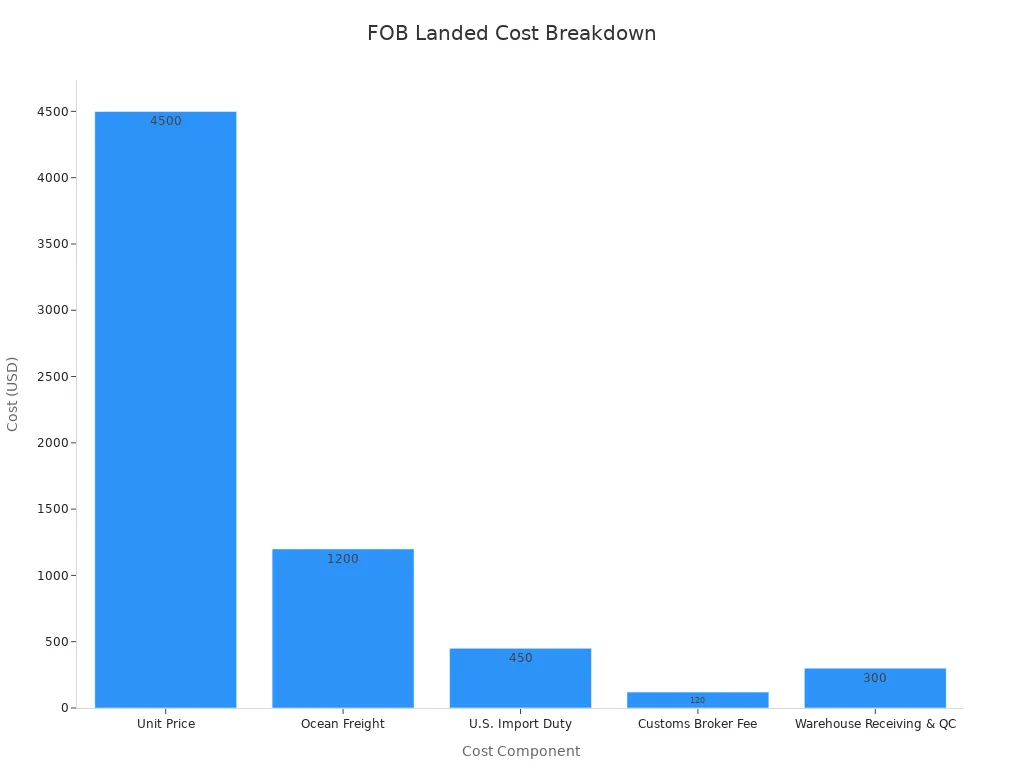
Your real cost is much more than the unit price. Landed cost covers product cost, origin handling, international freight, duties, taxes, customs charges, insurance, destination handling, inland delivery, and hidden costs like storage or repacking. The formula is simple: Landed Cost = EXW/FOB + To-Door Freight + Customs Fees.
Cost Component | Description |
|---|---|
Product cost | Unit price, packaging, labeling, palletizing |
Origin handling | Factory pickup, loading, export documentation |
International freight | Sea, air, or express shipping charges |
Duties and taxes | Customs duty plus import taxes on value |
Insurance | Cargo coverage for the shipment |
Destination handling | Unloading, customs filing, local transfer |
Inland delivery | Final-mile delivery to your warehouse |
Hidden costs | Storage, repacking, sorting, rework |
Sea freight gives the lowest cost per unit for big shipments. Air freight works well for urgent or high-value goods. Express shipping is best for samples and small trial orders. When you buy products in bulk, reliable shipping and correct landed cost math protect your profits. Corporate buyers who buy in bulk must count every fee before they commit to a wholesale order.
You must clear several legal steps before your phone accessories can enter the United States. The FCC controls electromagnetic interference and RF emissions for any device with a digital circuit or wireless feature. Products with Bluetooth, Wi-Fi, or NFC need FCC Certification from an approved lab. Simpler accessories may only need a Supplier's Declaration of Conformity.
California Proposition 65 adds one more layer. You must check your Bill of Materials for listed chemicals. Common worries in phone accessories include lead in solder, phthalates in cables and plastics, and cadmium in contacts. If any listed chemical goes above the safe harbor level, you must put a clear warning on the product label or packaging. If your company is outside the US, you must name a US-based entity as the responsible party on your FCC filing.
The European Union requires CE marking for products sold in its market. The RoHS Directive limits hazardous substances in electrical equipment. The Radio Equipment Directive sets safety, EMC, and spectrum efficiency rules. GDPR may also apply to connected products. Packaging rules differ by member state, so check local extended producer responsibility duties.
Asian markets each have their own rules. China requires CCC certification for many product types, which involves product testing and factory inspections. Japan demands MIC certification. India requires WPC compliance. Vietnam enforces mandatory SAR compliance for RF-emitting accessories.
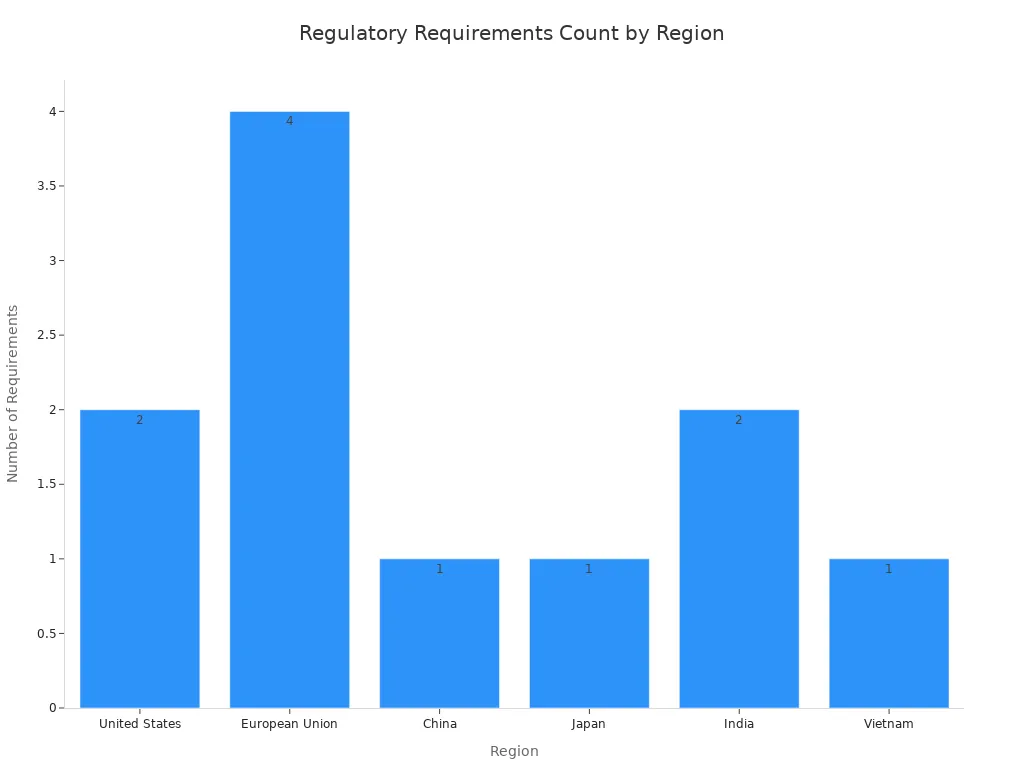
A wholesale mobile accessories supplier in San Francisco must also follow California-specific rules beyond Prop 65. These include state recycling fees and local disposal bans. Buyers sourcing premium mobile accessories wholesale San Francisco depend on local importers who already cleared these hurdles. When you buy mobile accessories wholesale, confirm every certificate matches your exact SKU and target market. Breaking the rules can lead to fines, recalls, or sales bans. Stay up to date through industry newsletters and trade associations. Adjust your procurement strategy as rules change.
Be careful when prices are much lower than what everyone else charges. A deal that seems too good often has a problem hiding behind it. Some sellers give you a low price first, then raise it after you order. Others use a special discount to trick you into paying a sales rep's personal account. Some even ask for more money for customs and threaten to keep your goods until you pay.
Fee stacking – The seller adds hidden charges to the item after the auction ends. Instead of one flat rate for postage and handling, the seller adds separate charges for postage, handling, and the shipping container.
The word "offer" can also be a warning sign. A salesperson may ask for your credit card to bill a package, then send order details that need more reservation requests. You might get another fee later. Many offers require upgrade costs to unlock the delivery dates they promised, and some add port charges, hotel taxes, or service fees on top. A trustworthy supplier gives you one clear price with every cost listed upfront.
Vague minimum order quantities create risk. A fair MOQ starts at 10 units per lot, and you should be able to get mixed-brand and single-SKU lots. If a seller won't state a firm MOQ in writing, treat that as a warning. You can't plan inventory or cash flow without a fixed number.
Warranty terms matter just as much. A weak warranty raises your total cost of ownership. Every broken unit becomes your expense when the seller offers no replacement policy. Ask for a written after-sales policy that covers defect rates, return windows, and replacement timelines. A supplier who avoids these terms will cost you more over time. Strong warranty coverage protects your quality standards and your budget.
A low unit price looks good on a spreadsheet. But that number hides the real cost of owning the product. You must add warranty claims, failure rates, and replacement purchases to see the full picture. A cheap product that breaks often costs more than a premium one that lasts.
Budget accessories fail more often. Established brands show about 2–3% out-of-box defect rates. Budget brands range from 8–12%. That gap means more warranty claims and more replacements for you. Warranty shipping usually costs $5–10 each way plus 7–14 days processing. A "free" replacement adds $15–20 in real terms.
Installation quality changes the math too. A $30 protector with full installation tools gets a 90%+ success rate. A $12 protector without tools gets only about 60%. You buy the cheap one again and again.
Tier | Unit Price | Replacement Frequency | Purchases over 24 Months | Total Cost (24 Months) | Monthly Cost |
|---|---|---|---|---|---|
Budget | $10 | Every 4 months | 6 | $80 | $3.33 |
Mid-range | $25 | Every 10 months | 3 | ~$82.50 | $3.44 |
Premium | $45 | Every 18 months | 2 | ~$95 | $3.96 |
Monthly costs stay within a $0.60 range across all tiers. Budget options do not give you real savings. You trade money for frustration, time, and protection that is not steady. A supplier who offers competitive wholesale pricing on premium goods gives you better long-term value.
Long lead times tie up your cash. You pay for goods weeks or months before they arrive. That money cannot go toward other business needs. Slow shipping also forces you to hold more safety stock. Extra inventory sits in your warehouse and costs money to store and insure.
Shorter lead times free up cash flow. You order closer to when you need the product. You hold less stock and reduce carrying costs. A reliable supplier with steady lead times helps you plan better. You avoid rush orders and pricey air freight. You also lower the risk of dead stock when product models change. Good quality and dependable delivery protect your budget over the full ownership cycle.
OEM and direct manufacturing make sense when your order size gets big enough to be worth the money. Custom logos, branded packaging, and special technology all need a manufacturer or supplier who can meet your specs. Small orders almost never hit factory minimums for custom tooling. You should check your yearly volume before you go down this road.
Corporate buyers who need unique colors, exclusive designs, or private-label products gain the most from OEM partnerships. When you buy and customize phone accessories for a large workforce, direct manufacturing lets you control materials and quality standards. You can ask for durable materials for protective cases and screen protectors. You can request drop-test standards for rugged protection. These choices matter when your brand relies on steady performance.
OEM arrangements give you flexibility. You get custom branding, exclusive product designs, and better margins at scale. You also take on more risk. You must check every supplier with care. A weak partner can slow production, miss quality targets, or fail to deliver on time.
X·ONE offers a structured partner support model that lowers these risks. The company gives material support, training support, marketing support, exhibition support, technical support, and after-sales support. This framework helps partners launch high-quality products and build relationships that last. You get access to over 180 patents and proven product designs. You also receive premium packaging and special technology.
A strong OEM partner shares your commitment to quality. They give you clear timelines, written warranties, and quick communication. They help you steer clear of the traps of weak MOQs and vague after-sales terms. When you pick the right supplier, OEM manufacturing becomes a smart advantage. You protect your brand, please your employees, and control your total cost of ownership.
You need to look at five things when buying premium phone accessories. You must check certificates, inspect material quality, make sure shipping is reliable, follow local rules, and figure out the real total cost.
A low price does not always give the best value for your company. Cheaper items break more often and cost you more money.
Use the checklist to check before you choose a wholesale phone accessories maker. Look closely for warning signs. When you buy mobile accessories in bulk, pick partners with good history. The phone accessories market gets more complicated every year. Working long-term with makers that give high-quality products lowers your risk. You get steady quality from trusted relationships that last past 2026.
Check each certificate with the group that gave it out. Look up FCC IDs in the FCC database. Check MFi license numbers at mfi.apple.com. Ask for full Declarations of Conformity for CE and batch-specific test reports from SGS or TÜV. A supplier who stalls or sends cropped screenshots does not pass this test.
It depends on your experience and cash flow. FOB gives you control over freight and insurance. CIF makes logistics simpler for newer importers. DDP puts the most responsibility on the seller at a higher unit price. Compare total landed cost before you commit.
| Incoterm | Who Pays Freight | Best For | | | | |
FOB | You | Experienced buyers |
|---|---|---|
CIF | Seller | New importers |
DDP | Seller | Door-to-door convenience |
Budget items break more often. Established brands show about 2–3% out-of-box defect rates. Budget brands range from 8–12%. Warranty shipping, processing time, and repeat purchases wipe out the savings. Premium phone accessories give you steadier value across the full ownership cycle.
A fair minimum order starts at 10 units per lot. You should get mixed-brand and single-SKU options. A seller who will not state a firm MOQ in writing creates planning risk. Fixed numbers let you manage inventory and cash flow with confidence.
Custom logos, branded packaging, and proprietary technology justify OEM at higher volumes. Small orders rarely meet factory tooling minimums. Structured partner programs, like the one X·ONE offers, provide material, training, marketing, and after-sales support. That framework lowers risk for wholesale mobile accessories buyers and mobile accessories for retailers alike.
Join X.ONE to access our best-selling original product,and leverage our end to end technical and marketing support to unlock new growth opportunities for your business.
 Material Support
 Training Support
 Marketing Support
 Exhibition Support
 Technical Support
 After Sales Support