
Aug 13,2026
How to find a reliable 3C accessories company for international distributors in 2026

You must pick a top phone case supplier using clear performance measures. You should focus on strong materials, exact phone fit, strict custom options, and safe shipping. Working with poor sellers creates big business risks. Broken stock leads to high return rates and unhappy buyers. Weak drop protection quickly hurts your brand's good name. Cheap materials turn yellow and look bad over time. Unplanned shipping delays mess up your selling plans.
You need trusted details to think about before picking a factory partner. Low-quality parts can easily ruin a custom phone case design. This guide gives a helpful testing plan for business buyers, online stores, and shop owners.
Test real phone case samples to make sure they offer strong drop protection and long-lasting surface coatings.
Pick adaptable suppliers that give you custom OEM designs and quick ODM making choices.
Buy bigger product groups to drop single item prices and skip secret equipment costs.
Check factory safety certificates and prepare for long shipping times from other countries.
You must test raw materials like thermoplastic polyurethane and polycarbonate to ensure strong structure, lasting durability, and toughness. High-quality parts resist yellowing, surface wear, and damage over long periods of use. You should check main material quality traits during early steps to guarantee an accurate device fit:
Cutout precision
Mechanical retention
Washability
You need to check vital drop protection features on every item line. Look for extra corner shock protection and inner honeycomb designs that lower impact force during falls. Good factories always do tough physical tests on each phone case structure to prove real shock defense.
The standard drop test height for military-grade drop protection approval (MIL-STD-810 Method 516.6) is about 1.2 meters (roughly 4 feet).
You should order real physical samples directly from your potential phone case supplier before making large orders. Factory partners add protective surface coatings to boost scratch resistance using simple methods:
Spraying
Dipping
Brushing
You need to check easy button clicks, camera safety, wireless charging, and raised screen edges on all phone case samples. Good surface coatings prevent ugly scratches and keep a clean look. Top sellers use smart oleophobic surface layers to block skin oils and stop smudges on every clear phone case. You must try each sample phone case in daily use to make sure it lasts long. Checking every custom phone case order ensures high safety for your buyers. This thorough testing steps help you choose safe vendor goods.
Evidence Type | Metric | Value |
|---|---|---|
Chemical resistance test | Contact angle retention after chemical exposure | Premium coatings maintain at least 80% of initial contact angle |
Industry standard | Water contact angle after 500,000 touch interactions | Above 90° |
Industry standard | Oil contact angle after 500,000 touch interactions | Above 60° |
Field test | Contact angle decrease after 3-6 months of regular usage | 30-40% decrease |
You should judge a phone case vendor by how well their factory adapts to your needs. Top partners provide both Original Equipment Manufacturing (OEM) and Original Design Manufacturing (ODM) options. Using OEM methods lets you build custom cases from your own blueprints and exact product details. Choosing ODM services gives you access to ready-made factory patterns. You can quickly add your private logo to these existing items.
Your business plans will show you the correct manufacturing path to choose. Making custom molds takes extra time, while using ready-made forms speeds up your sales. You can compare the average timelines for both production methods in this simple chart:
Production Type | Typical Lead Time |
|---|---|
ODM (Original Design Manufacturing) | 2–4 months |
OEM (Original Equipment Manufacturing) | 8–18 months |
You need strong custom choices to help your brand stand out in busy retail stores. Reliable factories use high-tech machines to print clear art right onto every case surface. You must check sample items to ensure sharp pictures, correct brand colors, and strong scratch resistance. Quality printing methods shield your artwork from daily rubbing and peeling over long periods.
Top factories support several simple ways to decorate plastic surfaces:
In-Mold Decoration (IMD) locks colorful graphics directly inside tough plastic layers
UV Digital Printing makes fast, detailed designs on your custom phone cases
Silk Screen Printing places bold single-color logos onto strong protective cases
You should ask for exact color matching on all your custom case orders. Good suppliers follow strict color codes to keep every product batch looking completely identical. You must also check that every decorated case has clean opening cuts. Careful factory trimming keeps phone ports open and buttons soft to press. Strong decorating methods keep your protective accessories looking fresh through years of daily use.
You should check factory order rules before buying your first product batch. Foreign suppliers set clear minimum order limits (MOQs) using design details and special tool needs:
Source | Product Type | MOQ for New Design |
|---|---|---|
huaruicorp.com | OEM New Mold Projects | 3,000–10,000 pcs |
lovingcase.com | Leather folio / card pocket cases | 500 units |
Buying bigger batches drops your single-item price through smart factory bulk savings. Simple TPU patterned cases run $0.60–$1.50 per item for 1,000-piece sales, while regular TPU+PC phone case options run US$1.50 each for 1,000 items. Stepped price levels offer clear savings on bigger orders:
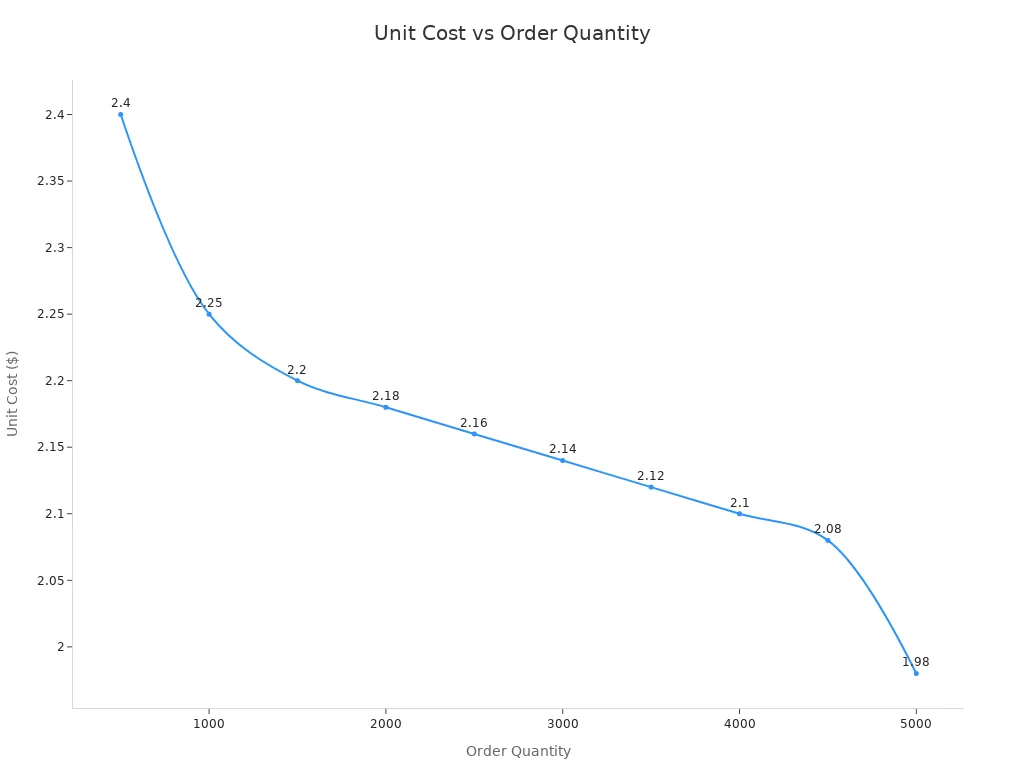
Ordering 500 items costs $2.40 per piece for a $1,200 total price tag. Raising your total order size to 5,000 items lowers your single-piece cost to about $1.98 per item.
You should settle on fair payment plans to keep your money moving smoothly. Foreign phone case factories usually ask for a 30% upfront fee before making goods and the rest before shipping. This basic setup protects both sides from unexpected financial losses.
Mixing custom mold fees directly into product prices inflates tax totals unnecessarily. In a $500,000 deal, bundled tool costs of $15,000 trigger $7,500 to $8,000 in extra import taxes. You must carefully watch for these sneaky extra expenses:
Custom shape molding and factory tooling fees
Test sample making and quick shipping costs
Failed quality checks and product repair work
Unplanned cargo fuel fees and extra port costs
International border taxes, tariffs, and import charges
An unlisted 25-cent fee added to one phone case order led to $850,000 in hidden tool charges over fifteen years. Keep mold fees away from item prices to shield your profits. Checking all supplier agreements closely keeps your business safe from costly surprise fees.
You must verify international standards before selecting a factory. Leading partners maintain certifications from SGS or TÜV. Recognized brands like X·ONE demonstrate full compliance across modern product lines.
“Promote your electronic accessory with MFi logos. Made for iPod, Made for iPhone, Made for iPad, and AirPlay logos communicate to customers that an electronic accessory has been designed to connect specifically to iPod, iPhone, or iPad, and has been certified by the developer to meet Apple performance standards.”
Global markets enforce RoHS and REACH rules for every custom phone case model. This table summarizes key compliance standards:
Aspect | RoHS | REACH |
|---|---|---|
Scope | Limits hazardous substances in electrical equipment. | Covers chemical substances in EU products. |
Key Requirement | CE marking and product certification. | Registration and supply chain declarations. |
Substances | Restricts 10 substances with specific limits. | Regulates over 235 SVHCs with a 0.1% threshold. |
You should schedule factory checks to inspect daily operations. Follow these steps during an audit:
Pre-audit preparation – Reviewing past performance and scope.
On-site opening meeting – Clarifying objectives with management.
Facility tour and document review – Inspecting operations and records.
Employee interviews – Validating workplace conditions.
Production line checks – Ensuring process stability.
Exit meeting and reporting – Sharing findings and next steps.
You must analyze delivery timelines to prevent supply chain disruptions. Your partner must ship inventory on schedule. A dependable phone case supplier maintains strict control over order fulfillment accuracy.
Freight options directly affect your warehouse stock. Ocean shipping from China to the United States requires planning. Less than Container Load (Sea LCL) takes 20-30 days. Full Container Load (Sea FCL) takes 25-35 days. Average sea transit times span 20-35 days.
You need to review shipping methods for every bulk phone case order. Air freight delivers urgent restocks fast. Ocean transit lowers costs on each heavy phone case batch. Secure freight logistics keep your clear phone case inventory stable across retail markets.
Selecting the ideal phone case supplier requires careful attention to critical business factors. You must demand high-grade materials, robust drop protection, flexible manufacturing, transparent financial terms, and verified compliance. Protecting your brand reputation depends entirely on maintaining these strict quality standards across your product catalog.
You can finalize a secure vendor partnership by completing three essential evaluation steps:
Request real production samples to test exact device fit, surface coatings, and material durability.
Conduct thorough factory audits to inspect daily operations and quality control processes.
Negotiate small pilot runs to verify order fulfillment accuracy and delivery timelines before placing large phone case orders.
Military-grade drop safety testing uses a set drop height of around 1.2 meters. This simple trial shows that your phone cases soak up hard falls. It ensures the covers shield delicate cell phones from sudden bumps.
You need to check outside testing proof from known groups like SGS and TÜV. Make sure your maker follows global RoHS and REACH chemical safety laws. Good sellers like X·ONE hold official Apple MFi approval for phone gear too.
Ocean shipping from China to the United States usually takes 20 to 35 days total. Smaller shared cargo loads take 20 to 30 days. Filling a whole shipping box takes 25 to 35 days to hit your store.
Overseas phone case factories mostly ask for a 30% down payment before making any goods. You pay the rest of the bill right before the seller sends your order. This regular setup keeps both sides safe from losing money.
Join X.ONE to access our best-selling original product,and leverage our end to end technical and marketing support to unlock new growth opportunities for your business.
 Material Support
 Training Support
 Marketing Support
 Exhibition Support
 Technical Support
 After Sales Support