 繁体中文
 Italian
 Spanish
 Thai
 Turkish
 Japanese
 Portuguese
 Russian
 French
 German
 Polish
 Arabic
Aug 19,2026
Top Experienced Companies Providing Mobile Protection Products Worldwide

Many suppliers look the same on paper. The brochures, the catalogs, and the price sheets all tell the same story. So how do you tell a dependable partner from a risky one in global mobile accessory supply chains? The answer rests on four moves. First, look beyond price. Second, use a fixed set of criteria. Third, run a structured evaluation process. Fourth, watch for red flags. Each move builds on the last. Together, they form a repeatable framework you can apply to any candidate supplier. You do not need luck or intuition. You need a steady method that lets you compare every supplier on equal terms.
Don't just look at the price. Watch out for hidden costs, like bad quality and late deliveries.
Compare suppliers in a fair and objective way by using six set criteria.
Use a clear test with samples, references, and a scorecard.
Pay attention to warning signs in communication, paperwork, and capacity.
Make your supply chain stronger by working with more than one approved supplier.
A low unit price hides several costs that show up later. Thin tempered glass can crack during sea freight when packaging standards are weak. Cable length can drift within the industry-standard tolerance of plus or minus 2cm, and that variation becomes a quality cost you absorb. Communication gaps around Chinese New Year and National Day can also break supply continuity when you fail to plan ahead.
Compliance adds another layer. CE marking is mandatory in the EU for chargers and power banks, and FCC ID registration applies to powered devices in the US. You are still legally responsible for final compliance, so check that the supplier's test lab holds ISO/IEC 17025 accreditation and confirm lithium-ion power banks meet UN38.3 transport testing. Ask for the full test report PDF before you approve production.
Then come the downstream effects. High defect rates, unstable delivery, batch-to-batch inconsistency, weak packaging, and poor certification compliance all lead to customer complaints, high return rates, negative reviews, and thinner margins. A cheaper unit price becomes more expensive once the product reaches the customer.
A holistic view weighs quality, stability, and support alongside price. Factory-direct benchmarks give you a reference point: defect rates below 0.3% and delivery times of 25–30 days show what a well-run operation looks like. Compare every quote against those benchmarks, and you see what a cheap price often hides.
Each sourcing model fits a different need. Factory-direct suits buyers who want control over quality control and long-run consistency. Distributors suit buyers who need breadth across phone parts and accessories and faster replenishment. Neither model wins by default. Your job is to match the model to your volume, your risk tolerance, and your support needs. That discipline protects your supply chain and keeps your global mobile accessory supply chains resilient.

A reliable distribution supplier partner earns trust through evidence, not promises. You should organize that evidence around six criteria: industry experience, product matrix, market validation, manufacturing capability, inventory management, and export experience. Each criterion answers a different question about the partner's staying power. Together they give you a repeatable way to compare candidates across global mobile accessory supply chains.
Industry experience separates a long-term supplier partnership from a short-lived trading arrangement. A typical supplier may show one to five years in the market and a single product line. A long-term brand partner usually brings 10+ years and 20+ product categories. Ask how long the company has operated and what it manufactures. Years of industry experience also reveal how many market cycles the partner has survived.
Product matrix depth matters just as much. A partner with broad SKU coverage can supply mobile phone parts and accessories from one source. Market validation adds proof: unit volumes, country reach, patents, and reseller networks show market trust. X·ONE illustrates what strong credentials look like. The brand has 28 years of mobile accessories expertise, carries 20+ product categories, and holds Apple MFi, Qi, SGS, and TÜV certifications. Treat such a profile as a benchmark, not a sales pitch.
Weigh three more factors inside the same criteria set, because industry experience alone does not cover them. Territorial protection defines where you can sell without internal competition. Marketing support covers materials, training, and exhibition help. Communication responsiveness shows how fast the partner answers questions during evaluation.
Quality control determines whether samples match bulk orders. Look for a documented process with full-process and inline inspection, an aging test of 48 hours, and a defect rate below 0.3%. Request test report PDFs and cross-check the lab against accredited bodies such as TÜV Rheinland or Intertek. Consistent product quality across batches protects your brand more than any single certificate, and it keeps your supply chain predictable.
Inventory and supply stability protect your replenishment cycle for phone parts and accessories. A strong partner manages 2000+ SKUs, quotes lead times of 25–30 days, and shares accurate stock information. International export experience covers shipping documents, packaging standards, and customs handling for international order fulfillment. Ask for proof of prior shipments to your region and confirm international export experience with your market's import rules.
Score every candidate on a fixed weighting so comparisons stay objective.
Evaluation Factor | Suggested Weight |
|---|---|
Product Quality | 25% |
Price Competitiveness | 15% |
Inventory & SKU Coverage | 15% |
Quality Control System | 10% |
Delivery & Logistics | 10% |
After-Sales Service | 10% |
Communication | 5% |
Export Experience | 5% |
Payment & Commercial Terms | 5% |
Total | 100% |
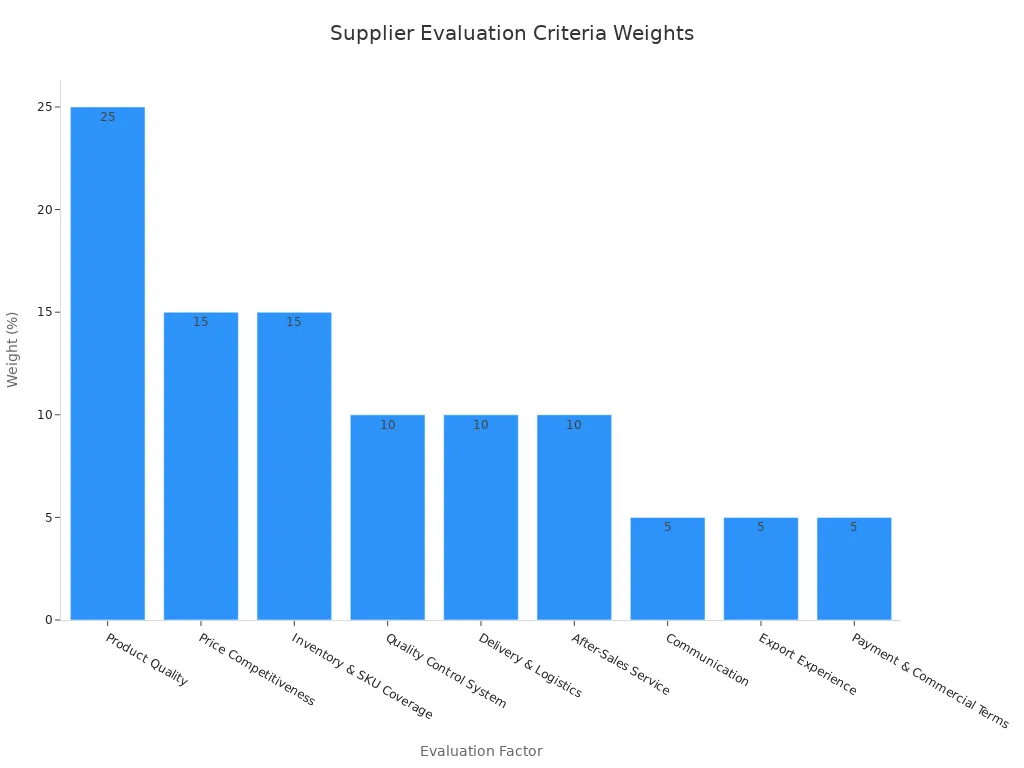
Use the scorecard as a working tool. Many mobile accessory distributors look strong on price and weak on documentation. A china-based distribution partner may offer excellent professional phone parts and accessories supply, yet you still need to verify export paperwork and after-sales terms. Global mobile accessory distributors often differ in supply chain management depth, so score each one on the same scale. No single score proves a reliable distribution supplier partner. The weighting keeps your supply-chain decisions honest across multiple sources.

You now have your criteria. The next step is to turn those criteria into evidence. Ask for samples, check references, and score every candidate on a fixed scorecard. This order keeps comparisons fair across global mobile accessory supply chains.
Start with a complete sourcing brief. List model compatibility, material and finish needs, cable length or charging specs, packaging style, barcode needs, quantity, destination country, and target budget. Lock the specification at a level you can check. Define material grade, dimensions, tolerances, color, components, ratings, workmanship limits, packaging, and labels. Attach a dated revision and require written approval before any substitution.
Then follow a fixed sample routine:
Check device-model fit and charging or data speed on samples before you approve volume.
Share reference materials — photos, links, drawings, finish notes, and packaging examples.
Ask for documents early. State your market's CE, FCC, RoHS, battery, manual, label, and barcode needs upfront.
Follow up on sample notes, photo or video checks, and open technical points.
Compare suppliers on confirmed specs, materials, MOQ, lead time, document availability, and inspection cooperation — not price alone.
References work the same way. Ask a phone parts wholesale supplier for buyers in your region and confirm shipment history. Check industry experience and export experience before you make a shortlist. A phone repair parts supplier china buyers trust will show international export experience and a record of international order fulfillment. A good phone parts distribution supplier answers these questions without hesitation. Compare mobile accessory distributors on the same points.
A broad-sku distribution partner makes sourcing for phone parts and accessories simpler. One purchasing relationship covers screens, batteries, charging accessories, and cases. You get a single point of contact, combined ordering and payment, consolidated quality control, combined shipping, unified inventory management, and centralized after-sales communication. Strong sku coverage and supply-chain integration let a china-based distribution partner serve as your mobile phone parts and accessories source. A phone parts and accessories supplier with broad sku coverage cuts the number of vendors you manage.
Because phone parts are highly model-specific, a supplier with a broad product portfolio can reduce the number of suppliers an importer must manage — simplifying purchasing, payment, quality inspection, consolidated packaging, shipping, documentation, and after-sales communication.
A narrower specialist still fits when you need deep expertise in one category, such as a mobile phone spare parts distributor focused on displays. Match the model to your range.
Score phone parts and accessories candidates against fixed areas so comparisons stay fair. Compare sku coverage across candidates on the same scale.
Evaluation Area | What to Evaluate | Why It Matters |
|---|---|---|
Model coverage | Breadth of recurring device models | Reduces supplier fragmentation |
Compatibility control | Accuracy of model verification | Reduces wrong-part orders |
Sample support | Ability to validate before volume orders | Reduces bulk risk |
Batch consistency | Repeatability of approved specification | Protects production yield |
Mixed-SKU sourcing | Ability to combine different models | Simplifies purchasing |
MOQ flexibility | Quantities suitable for real demand | Reduces excess inventory |
QC communication | Clear inspection expectations | Reduces quality disputes |
Packaging | Protection and SKU identification | Improves warehouse efficiency |
After-sales | Defect and replacement process | Reduces downtime |
Communication | Technical clarity before ordering | Prevents avoidable errors |
Ask how the supplier records a defect, whether photos or videos are required, and how confirmed defects are replaced or credited. A reliable distribution supplier partner is judged by how well both sides solve a problem. Weigh industry experience, export experience, quality control, and supply chain depth one last time before you commit to a professional phone parts and accessories supply partner.
Red flags rarely show up as one big dramatic event. They appear as small inconsistencies you notice during evaluation. Treat each one as a reason to ask a follow-up question, not as proof of bad faith. A supplier may simply have weak processes. Your job is to find out which.
Watch how a candidate communicates before you place any order. These patterns deserve a closer look:
Category | Common Red Flags |
|---|---|
Communication | Free email accounts instead of a company domain; contact names, phone numbers, or addresses that don't match within one deal; evasive answers about documents or references; strong pressure to pay fast |
Documentation | Refusing or delaying IMEI logs before payment; missing FCC ID numbers or proof of origin; claims that paperwork "comes after delivery"; generic, unbranded invoices and grading reports |
One buyer described a bulk phone supplier who started out professionally. Once IMEI logs were requested, emails came from different addresses with different signatures, calls were avoided, and wire transfers were pushed. The domain traced back to a newly registered overseas site. In a separate 2022 case, a reseller paid a supplier who refused to share IMEI logs upfront and got a batch where over half the devices were carrier-blacklisted, a $75,000 loss. IMEI verification would have prevented it.
Capacity problems show up in numbers, not adjectives. Ask every phone parts and accessories supplier for lead time data across recent orders. A standard deviation above 10% signals delivery you can't predict. Ask for defect rates too. A rate above 1–2% points to output that isn't consistent. Both figures affect your inventory management planning directly.
Watch for these capacity signals:
Lead times that shift between quotes with no explanation
No real-time stock visibility, so order status stays a mystery
No cycle counting program, which hides accuracy problems
Resistance to scaling with your growth
Quality claims that change between samples and bulk orders
Protect yourself with structural safeguards. Keep 2–3 suppliers per critical item. Build lead time buffers using average lead time plus one standard deviation. Check quality control records at every stage, and confirm sku coverage matches your model range. A dependable phone parts and accessories supplier welcomes these questions. A weak one avoids them. Either way, you learn what you need for a resilient supply chain and a stable supply-chain partnership.
You now have a framework you can use again and again. Look past price, apply the same six criteria to every candidate, and run a structured evaluation with samples, references, and a fixed scorecard. Pay attention to the red flags you spot along the way. Each step turns a vague impression into evidence you can compare.
A trusted partner comes from a careful selection process. Luck plays no part in it. You build reliability through consistent scoring, verified documents, and honest talks about quality and capacity.
Start today. Make a shortlist of candidates for your phone parts and accessories range, open your scorecard, and send sample requests. The first comparison will tell you more than any brochure.
Shortlist at least three candidates for each critical item. Score each one on the same weighted scorecard. Keep two to three approved suppliers for each critical item in your ongoing supply chain. This spread protects your replenishment cycle when one partner hits a capacity limit.
Ask for full test report PDFs, not summaries. Confirm the lab holds ISO/IEC 17025 accreditation. For powered devices, request CE marking evidence and FCC ID registration. For power banks, verify UN38.3 transport testing. Request references from buyers in your region and confirm shipment history.
Lock the specification in writing with a dated revision. Define material grade, dimensions, tolerances, and packaging. Require written approval before any substitution. Then compare bulk output against that approved spec through inline inspection and a 48-hour aging test. A defect rate below 0.3% shows the process holds.
Use 25–30 days as a factory-direct benchmark for delivery. Ask for lead time data across recent orders and calculate the standard deviation. A deviation above 10% signals delivery you cannot predict. Build buffers using average lead time plus one standard deviation.
Neither wins by default. A broad-SKU partner simplifies purchasing, consolidated quality control, combined shipping, and after-sales communication across phone parts and accessories. A narrow specialist fits when you need deep expertise in one category, such as displays. Match the model to your range and volume.
Join X.ONE to access our best-selling original product,and leverage our end to end technical and marketing support to unlock new growth opportunities for your business.
 Material Support
 Training Support
 Marketing Support
 Exhibition Support
 Technical Support
 After Sales Support