 繁体中文
 Italian
 Spanish
 Thai
 Turkish
 Japanese
 Portuguese
 Russian
 French
 German
 Polish
 Arabic
Aug 07,2026
Finding a suitable supplier for importing screen protectors and phone cases in 2026
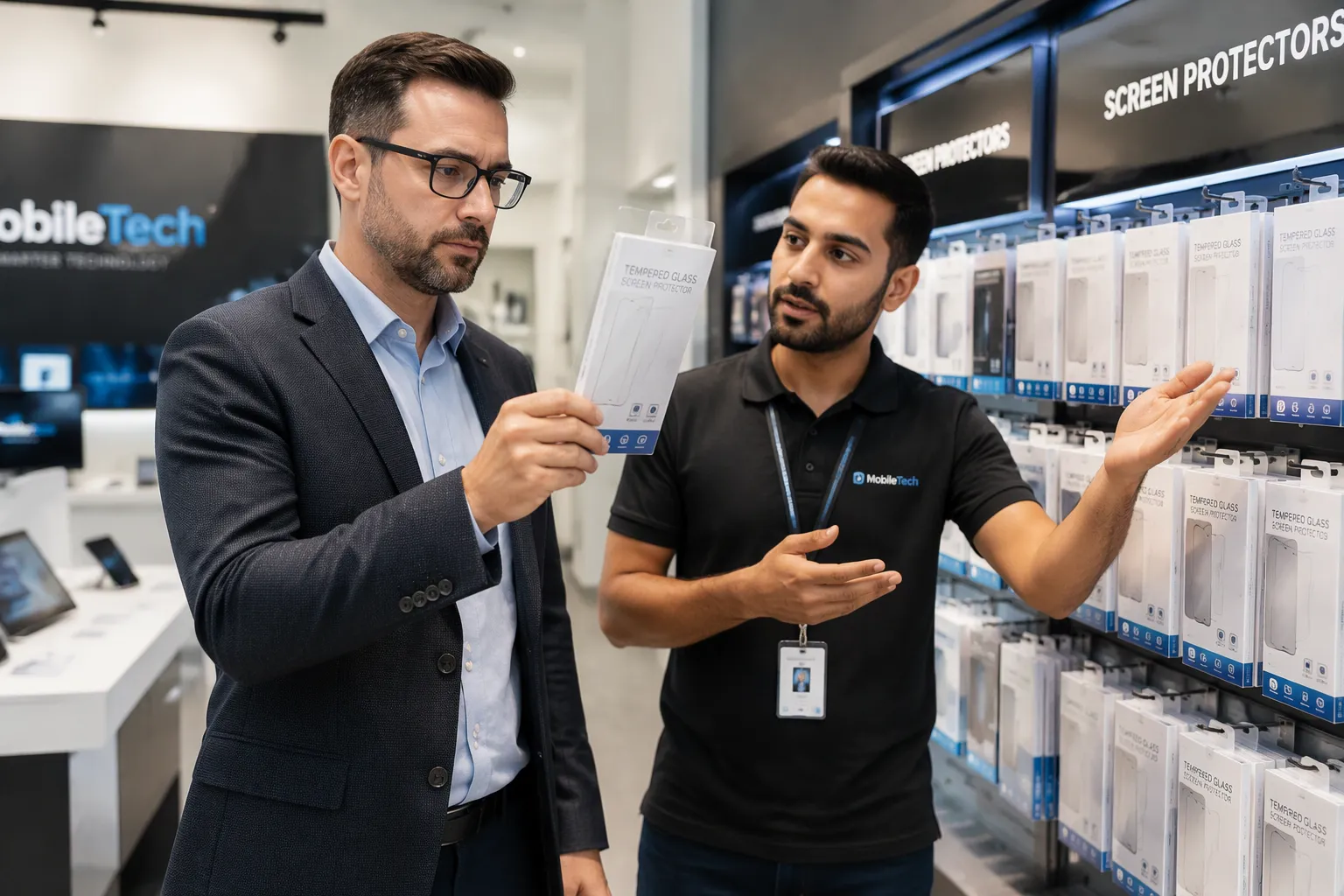
Screen protectors sell well in almost any store. But the wrong supplier still hurts your business. Returns go up, compliance paperwork gets stuck, and top-selling models run out of stock at the worst time. That gap costs you money every quarter.
So how do you pick a premium screen protector provider for retail distribution? Start with a practical framework. It should cover sourcing routes, product specs, landed cost, and compliance. This screen protectors buying guide compares every option honestly. Retail buyers will see where each sourcing model fits your volume and your risk tolerance. Treat it as a working buying guide before you commit to a screen protector line.
Pick a supplier that offers many kinds of screen protectors. This helps you meet different customer needs and price points.
Check product specs like 9H hardness and curved-edge fit using test reports and samples. This helps lower returns.
Pick the sourcing route that fits your order size: use a factory for big orders, a distributor for more flexibility, and a marketplace for small tests.
Figure out the real landed cost per unit by adding freight, duties, and defect costs to the unit price.
Check the supplier's references and return policies. This helps ensure reliable after-sales support and long-term profitability.
Your product line needs to be wide enough to serve different customers. Make tempered glass your main volume seller. Add blue-light, anti-reflective, anti-glare, anti-microbial, shock-absorbing, and ultra-thin options to cover special demand. A premium provider should offer standard, premium, and privacy tiers. This setup lets you serve budget shoppers and premium buyers at different price points. Each screen protector type targets a different buyer. Match each format to a customer segment before you order.
Tempered glass is still the workhorse of any screen protector lineup. It gives reliable screen protection at a price that sells. Pair it with a glass screen protector variant for customers who want a thinner feel. Blue-light and anti-glare versions appeal to office workers and outdoor users. Anti-microbial options fit healthcare and shared-device settings. Ultra-thin models attract buyers who dislike bulk. Each type earns retail shelf space when you match it to your customer base. A strong tempered glass program anchors the whole category. Tempered glass also resists scratches well, which keeps returns low. Tempered glass suits most devices.
Privacy screen protectors depend on material choice to control light direction. Micro-louver film blocks side viewing while keeping the front view clear. This construction sets the privacy angle, usually around 30 degrees off-center. A narrower setting means stronger privacy protection but less sharing flexibility. Premium privacy screen protectors add extra layers for durability. Test each sample under bright light to judge the effect.
Privacy screen protector materials directly shape optical clarity and viewing angle. Cheaper privacy filter film can dim the display or blur text. Premium privacy screen protectors use refined micro-louver layers for sharper images. Material quality also affects durability and bubble resistance. When you evaluate privacy filters, test the viewing angle from several positions. Ask suppliers how their privacy screen protector materials hold up after repeated cleaning. The best screen protector for privacy buyers balances a tight viewing angle with a bright, clear display. Compare samples of privacy screen protector materials before you commit. Ask for a demo unit and check it in store lighting.
Each sourcing route works for a different kind of buyer. A factory lets you control specs, packaging, and price directly. You also get custom tooling and private-label programs. The catch is commitment: factories set the highest minimum order quantities (MOQs), often per model and per SKU. A marketplace is the easiest place to start. You can test a screen protector line with small batches and fast shipping. The downside is little differentiation, limited customization, and uneven seller quality. A distributor falls in the middle. You get mixed-model orders, local stock, and shorter lead times, but you pay a margin for that convenience.
Route | Strengths | Watch-outs | MOQ level |
|---|---|---|---|
Factory | Custom specs, packaging, best unit price | High commitment per SKU | Highest |
Marketplace | Fast testing, small batches | Little differentiation, variable sellers | Lowest |
Distributor | Mixed models, local stock, quick replenishment | Higher unit cost, less control | Moderate |
Your order volume and risk tolerance decide the route. Small retailers and new categories do best with a distributor or a marketplace pilot. You learn which models sell before you spend big money. Mid-size chains often mix routes: distributor stock for fast movers, factory terms for hero SKUs. High-volume buyers gain the most from factory-direct agreements, where unit cost and packaging control add up across the retail supply chain.
Big players set the baseline. Best Buy and Amazon shape what consumers expect for packaging, compatibility claims, and delivery speed. Your provider must meet that bar in every retail channel. Ask each candidate how they support distribution at your scale. Request a sample order and a landed-cost quote before you sign.
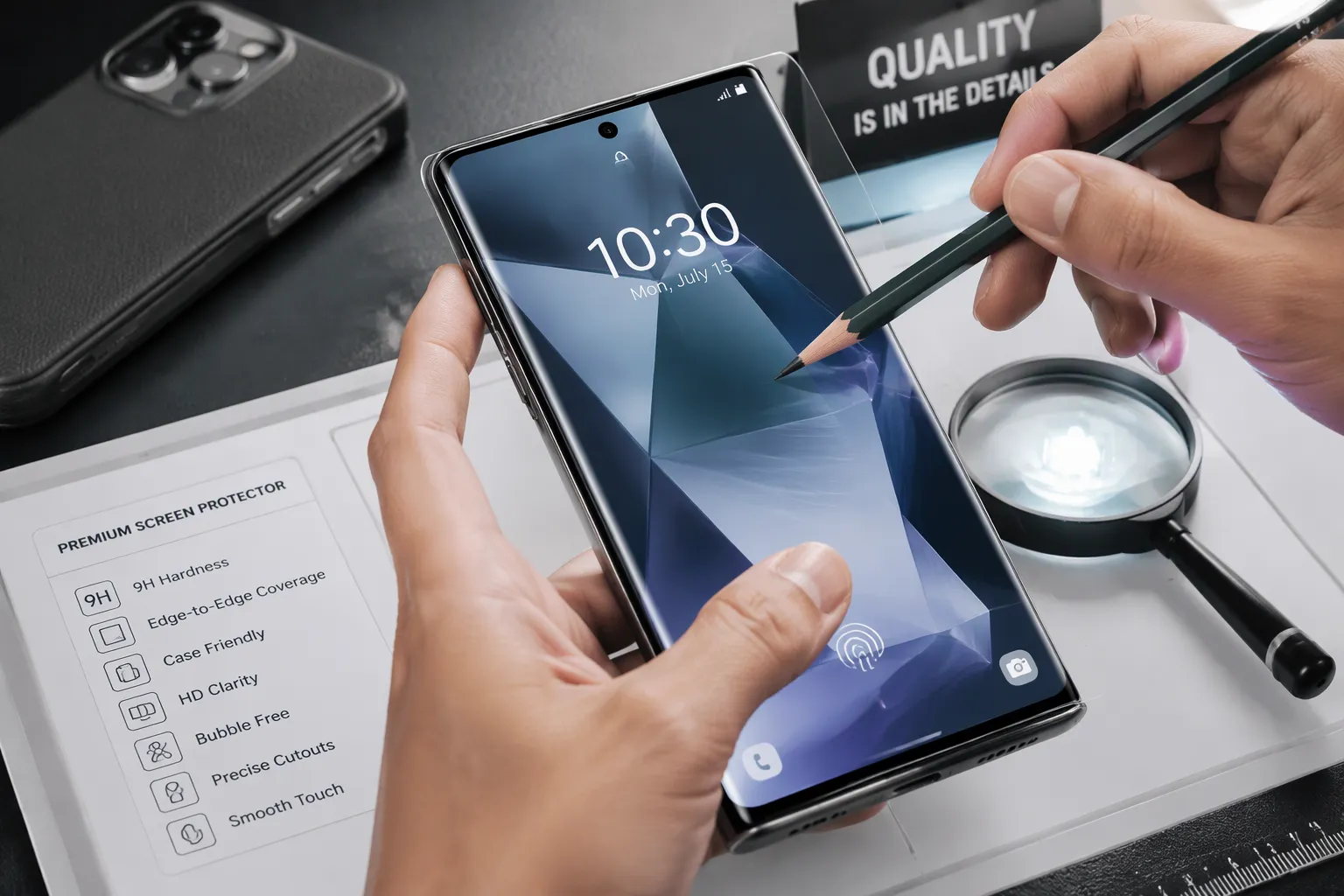
Three specs separate a real premium screen protector provider from a label printer. You need verified 9H material hardness, full-device coverage compatibility for curved-edge models, and reliable quality standards you can audit. Skip any one of these, and your returns rate will tell the story.
The 9H rating comes from the pencil hardness scale. A 9H surface resists scratches from a pencil of that grade under standardized test pressure. It does not mean the protector is unbreakable. It means the surface holds up to daily abrasion from keys, coins, and pocket grit. Ask every candidate for test reports, not marketing claims. Scratch resistance claims without documentation mean little.
Adhesion matters just as much. Weak adhesive leaves bubbles and lifting edges. Strong adhesive can trap dust permanently. A quality screen protector uses high-quality materials that bond cleanly and release without residue. Check optical clarity under bright light. Haze, rainbow effects, or a dimmed display signal cheap film. Optical clarity separates a glass screen protector worth shelf space from one that drives returns.
Curved-edge phones punish generic protectors. Full-device coverage demands edge-to-edge fit, precise cutouts, and case-friendly tolerances. Request samples for your top curved models and fit them yourself. A protector that lifts at the corners fails in the customer's hands, not yours.
Drop protection gives you a benchmark to compare. Look for protectors rated to survive drops of up to 3 feet, the typical fall from hand height. Impact resistance beyond that baseline signals serious engineering. X·ONE illustrates this tier well. Its DNA Guard 6m drop protection combines multi-layer absorption with a honeycomb structural design. EnduraClear™ anti-yellow technology keeps clarity over time. AR Pro Coating reduces reflection, and Nano Coating supports durability and easy cleaning. These features show what a premium screen protector provider can build into a single product.
Use this table to score candidates against the non-negotiables:
Spec | What to verify | Why it matters |
|---|---|---|
Hardness | 9H test report | Scratch resistance you can trust |
Coverage | Curved-edge fit samples | Fewer fit-related returns |
Drop rating | 3-foot benchmark or better | Real-world impact resistance |
Clarity | Visual check under bright light | Optical clarity and customer satisfaction |
A best screen protector claim means nothing without evidence behind it. Demand documentation for every spec. That habit sets the standard for premium retail sourcing.
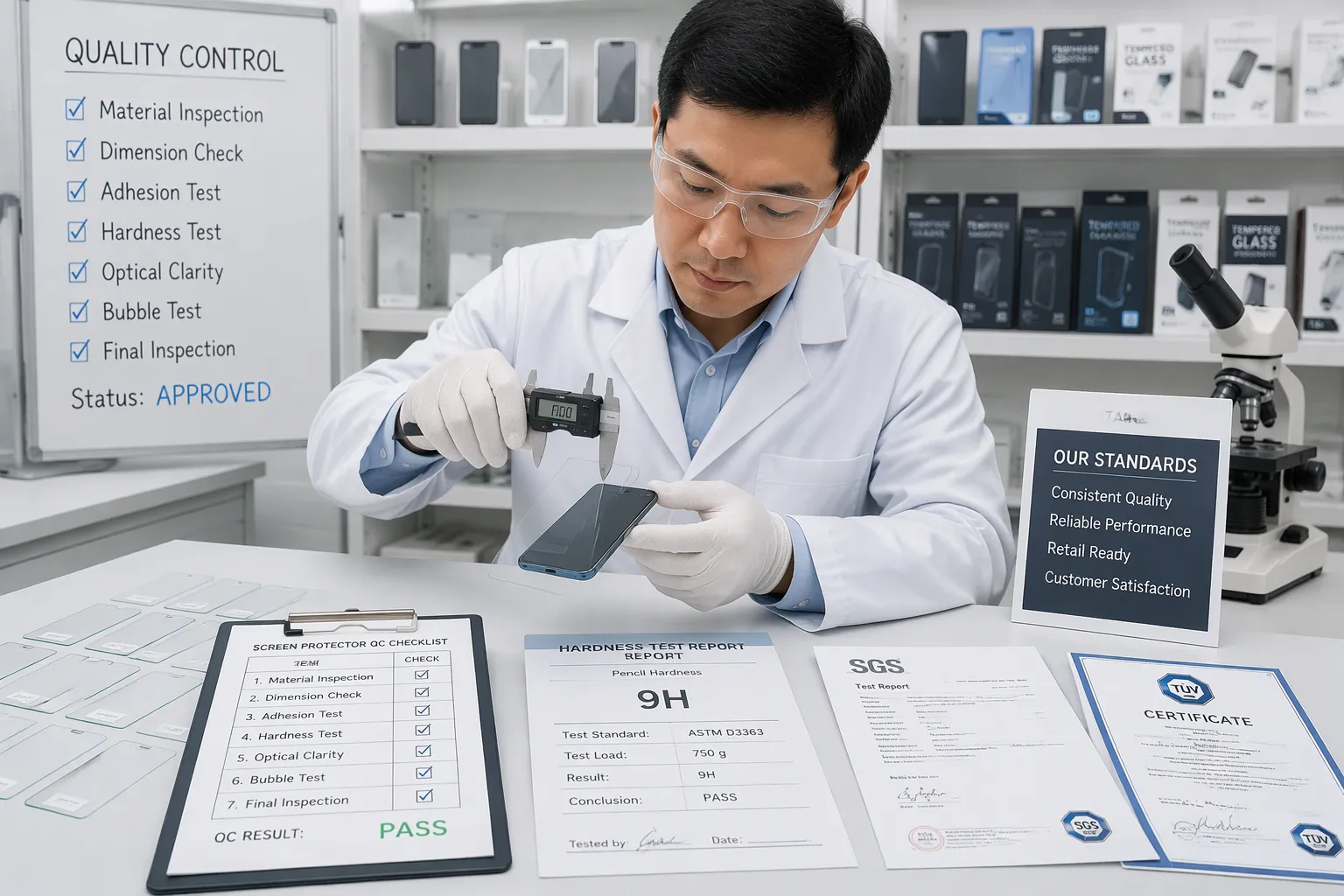
Put every candidate through the same steps. This routine keeps your review fair and your records clean.
Check hardness claims. Ask for a 9H test report from a known lab. Compare the report date and the tested model with the SKU you plan to order.
Confirm coverage compatibility. Send your top device list to the supplier. Ask them to confirm curved-edge models, cutout positions, and case-friendly edges.
Request samples. Order production samples, not golden samples. Fit them yourself on real devices and check clarity, adhesion, and edge lift.
Check certifications. Look for Apple MFi approval, Qi wireless certification, and testing by SGS and TÜV. Ask for certificate numbers you can check.
Review patents and awards. Patents show real engineering investment. Awards add outside credibility to the brand story your staff will tell.
A strong track record shortens this vetting work. X·ONE shows the profile to look for: more than 180 patents, over 100 million units sold, a presence in more than 60 countries, and a network of over 5,000 resellers. Numbers like these show a premium screen protector provider that has survived real retail pressure across many markets. Ask each candidate for similar evidence. Treat vague answers as a warning sign.
Specs win the sample round. Terms win the contract. Put every commercial detail in writing before you commit.
Confirm the MOQ per model and per SKU. Clarify the price breaks at higher volumes. Ask how the supplier handles mixed-model orders and whether they support private-label packaging. Check payment terms, deposit percentages, and currency. Request the production lead time and the shipping lead time as separate figures. Then ask for the replenishment lead time on repeat orders, which often differs from the first order.
Lead-time claims deserve a test. Place a small trial order and track it against the promised dates. Record the actual ship date, the transit time, and the arrival condition. This trial reveals more than any sales presentation. Build a buffer into your first seasonal buy until the supplier proves reliable.
Lock down the quality terms too. Agree on an acceptable defect rate, a returns process, and a warranty period for the screen protectors you stock. Ask who covers freight on defective units. Confirm that the supplier will honor the same quality standard on reorders, not just the first batch. A provider who welcomes these questions usually has the systems to back them up.
Unit price is the first number every supplier quotes. It is also the number that fools most buyers. Make your own landed-cost table and compare candidates on the total figure. Start with the ex-works unit price, then add freight, duties, insurance, and packaging customization. Add inspection fees and the cost of defective units you must replace. Divide the total by the sellable units in the shipment. That result is your true cost per unit on the shelf.
Read the table column by column, not row by row. A supplier with a higher unit price may win on freight consolidation or lower defect rates. A cheap quote with weak packaging often loses money through returns. Model your maximum retail margin at your planned shelf price, then stress-test it against a realistic return rate. Protect long-term profitability by comparing total cost of ownership across a full season, not a single order.
Platform choice changes your cost structure as much as your supplier does. Compare candidates on the same criteria so the decision stays objective.
Criterion | What to compare |
|---|---|
Pricing transparency | Published tiers versus quoted terms |
MOQ flexibility | Per-model versus per-order minimums |
Customization | Private label, packaging, tooling |
Lead time | First order versus replenishment |
Support | Training, marketing, after-sales |
Run the same sample order through two or three platforms. Track the real invoice, the arrival date, and the condition of every screen protector in the box. A platform that answers questions quickly before the sale usually supports you after it. Choose the route that fits your volume, then negotiate terms that protect your margin as you scale your retail program.
Reviews show you how a supplier does after the sale. Start with the one-star and two-star reviews. Look for patterns, not just single complaints. If many people mention edge lift, bubbles, or cracked corners, that points to a quality problem. If many mention wrong models in the box, that points to a fulfillment problem. Both patterns mean returns in your store.
Your own return data matters more than any public review. Track returns by model, by batch, and by reason code. A screen protector with a high fit-related return rate will eat into your margin. Compare that rate against the defect allowance the supplier promised. Ask the supplier to explain any gap between their claim and your numbers. A supplier who goes over your data with you shows real commitment to long-term profitability.
Ask every shortlisted provider for two or three reference accounts. Pick references that match your channel and your order size. A large online seller faces different pressures than a small retail chain. Ask each reference how long they have stocked the brand. Ask about how fast repeat orders are refilled.
Then move to the harder questions. How often do shipments arrive short or late? How does the supplier handle defective units? Does the packaging hold up in transit and on the shelf? Ask about durability complaints specifically, since these show up months after purchase. Finally, ask whether the reference account plans to keep stocking the line. A hesitant answer tells you more than a polished sales pitch. Weigh every answer against the evidence you gathered from samples and return data.
Premium providers make custom packaging for retail distribution. Ask for retail boxes, card inserts, and polybags that fit your shelf and online listings. Strong packaging protects the product in transit. It also carries the compliance marks your channel requires. Request a printed dieline and a physical sample before you approve a print run. Check barcode placement, model labeling, and the language on the back panel.
Partner support is what sets a premium provider apart from a basic one. Look for technical and marketing support, staff training, exhibition support, and after-sales service. X·ONE's partner program shows this model in practice. Partners gain access to high-demand products, premium packaging, unique selling propositions, and proprietary technology. That support helps your team sell the screen protector line with confidence. Ask each candidate what training and marketing assets they provide at your order volume.
Storage conditions affect product quality before the customer opens the box. Ask the supplier for the recommended temperature range and humidity limits. Keep cartons off concrete floors and away from direct sunlight. Stack boxes only to the height the supplier approves. Adhesive layers and coatings can break down under heat or pressure over time.
Shelf life deserves a place in your contract. Request the stated shelf life for each SKU and the production date on every carton. Rotate stock so older batches sell first. Inspect a sample from each batch for edge lift or yellowing before it reaches the sales floor. A provider who documents shelf life and batch dates protects your retail margin. Add these terms to your supplier agreement before the first shipment.
First, figure out how many units you plan to order. Then compare where you buy from, check product specs with samples, and make sure the paperwork is in order before you sign. This plan helps you turn a crowded supplier market into a short, strong list.
If you order in large amounts, factory-direct terms and custom packaging usually work best for you. Smaller stores do better with a distributor's flexibility and mixed-model orders. Pick the route that fits how much risk you can handle, not just the lowest price.
Now take one step. Ask two providers on your shortlist for samples and a landed-cost quote. Compare the real numbers, then pick the premium screen protector provider that protects your margin and your screen protector line.
Factories ask for the largest minimums, usually per model and per SKU. Distributors take mixed-model orders at medium minimums. Marketplaces let you test with the smallest batches. Match the minimum to your proven sales before you sign a factory deal.
Ask for a 9H test report from a known lab. Compare the report date and tested model with the SKU you plan to order. Treat any claim without paperwork as unproven. The 9H rating covers surface scratch resistance, not shatterproof performance.
Look for Apple MFi approval, Qi wireless certification, and testing by SGS and TÜV. Ask for certificate numbers you can check on your own. These marks confirm safety and performance claims. A provider who hesitates on paperwork rarely meets retail compliance standards.
Place a small trial order first. Track the real ship date, transit time, and arrival condition against the promised dates. Check samples from each batch for edge lift or yellowing. Build a buffer into your first seasonal buy until the supplier proves reliable.
Ask for technical and marketing support, staff training, and after-sales service. Find out what assets the provider gives at your order volume. X·ONE's partner program shows the standard: premium packaging, proprietary technology, and exhibition support. Weak post-sale support shows up later as returns and stockouts.
Join X.ONE to access our best-selling original product,and leverage our end to end technical and marketing support to unlock new growth opportunities for your business.
 Material Support
 Training Support
 Marketing Support
 Exhibition Support
 Technical Support
 After Sales Support