 繁体中文
 Italian
 Spanish
 Thai
 Turkish
 Japanese
 Portuguese
 Russian
 French
 German
 Polish
 Arabic
Sep 11,2026
How to Select a Supplier for International Mobile Accessory Distribution
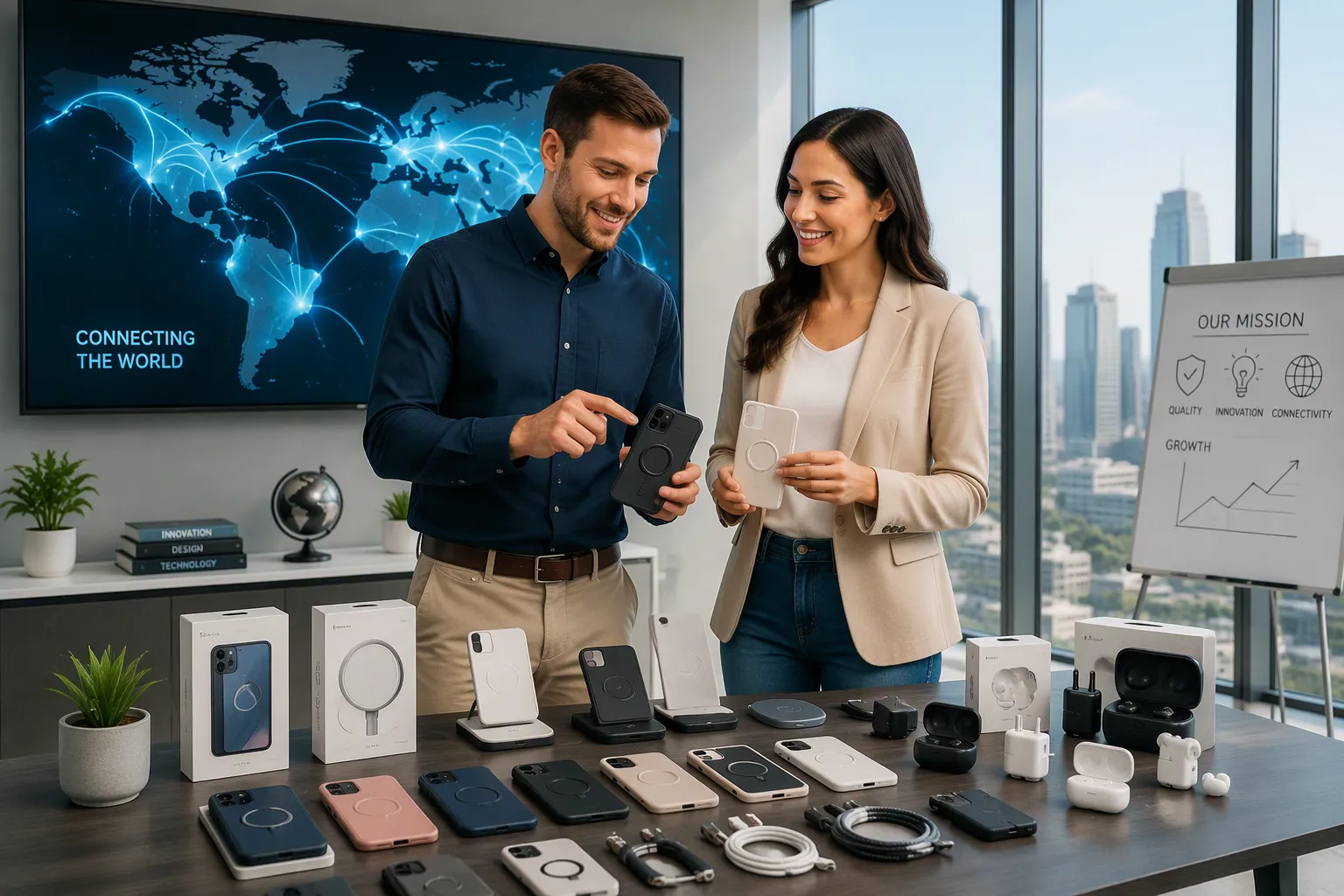
How do you choose a global mobile accessory partner that fits your products, your markets, and your growth plans? Start with your own priorities. Which product categories do you sell? What order volume do you need? How fast must delivery run? Which regions must the partner serve?
Your answers shape every decision that follows. This guide compares partner types and the services a strong partner should offer. It also walks through a step-by-step selection process, highlights reliability signals, and flags common pitfalls. Read each section through the lens of your own business.
Figure out what products you need and how many you want to order before you reach out to any supplier.
Pick the partner type that fits your business model: factory-direct for large volume, distributors for speed, and trading companies for flexibility.
Look for certifications like MFi, Qi, and CE to make sure products are safe and good quality.
Check samples and confirm quality control before you place big orders.
Begin with local partners if you are small, then move to overseas sourcing as you grow.
The global mobile accessories market was worth $105.5 billion in 2025. Experts expect it to hit $189.9 billion by 2033, growing at a 7.8% CAGR. That size makes partner selection more important. In a market this big, a weak link in your supply chain costs you sales.
Distributors buy phone accessories in bulk from manufacturers and larger importers. They gather products from many makers and pick assortments that match common devices and current trends. Many also broker private-label and customization programs for retailers who want their own brand.
Inventory and logistics are the operational core. Distributors keep stock in local or regional warehouses and run replenishment programs. You can restock bestsellers without renegotiating every order. They handle shipping, offer fast delivery, and manage dropshipping for online stores. Overseas sourcing adds customs and import complexity, which they take on for you.
Market access and after-sales coordination complete the picture. Distributors link manufacturers to retailers, repair shops, and online sellers. They provide product photos, spec sheets, and point-of-sale displays. They also handle returns, replacements, and warranty claims, especially when they hold brand authorization.
The right partner gives you an edge competitors cannot easily copy. A manufacturer that can redesign or customize mobile phone accessories, such as personalized cases, lets you make your range different. You then set margins that protect profit while still giving consumers a fair deal.
Selection criteria have moved toward measurable performance. Modern buyers weigh quality metrics, production stability, SKU scalability, OEM/ODM capability, and channel protection. Factory-direct relationships can cut out wholesaler markup, and some partners let distributors keep 15%–40% margin as a market-expansion budget. Quality benchmarks matter too: a defect rate below 0.3% shows tight process control. Channel protection models, such as national exclusivity, keep pricing stable and stop internal competition. Pick a partner whose strengths match your growth plan, and your phone accessories business gains a lasting advantage.
A factory-direct manufacturer makes the product and sells it to you with no middle layers. This path works for buyers who need volume, control, and full customization. Tier-1 manufacturers show their skill in fast charging with GaN technology, MFi and USB-C data cables, protective cases, and wireless audio. They check incoming materials, run inline quality control, test how products work, and run aging tests. A defect rate below 0.3% and a 25–30 day production cycle are common benchmarks at this level.
Distributors are closer to your market. They stock wide ranges from many makers and refill your orders fast. Pick this type when breadth and speed matter more than deep customization. Trading companies sit between the factory and the regional distributor. They offer flexibility and variety, but you should confirm who owns product documents, quality checks, and after-sales handling.
Your business model points to the right partner type. The table below maps common models to priorities and pre-RFQ checks.
Business model | Prioritize in product range | Check before sending an RFQ |
|---|---|---|
Retail / ecommerce resale | Fast-selling SKUs, consistent packaging, stable reorders | SKU list, barcode and label rules, sample approval |
Distributor / regional wholesaler | Wide range, repeat supply, channel support | Category depth, replenishment cadence, launch rhythm |
OEM/ODM / private label | Custom specs, packaging, branding | Customization scope, MOQ impact, tooling, document ownership |
Promotional / bundle buyer | Simple items, flexible packaging, timing | Color options, logo method, packing quantity, lead time |
For mixed lines, choose the supplier that explains both its range and its order process clearly. Ask whether it covers your main categories without forcing unrelated items into the order. Confirm it keeps wholesale stock separate from OEM/ODM projects. Talk about product specs, packaging, and target markets before pricing. Check that it can explain documents for chargers, wireless products, and battery items. A clear path for samples, quotes, reorders, and after-sales questions shows a workable fit.
For distributors, brand and channel support may matter as much as the product itself. Review partnership support before you assume a standard wholesale order is the right path.
A strong partner does more than just send boxes. It handles the whole trip from factory to shelf. Look for global sourcing that checks and approves manufacturers based on your specs, volume, and timeline. Ask if the partner offers backup sourcing options and manages supplier relationships for you. Production management matters too: sampling, clear quality control, factory oversight, and making sure final output matches approved samples.
Logistics and fulfillment decide your service level. The table below shows what full-service support looks like.
Service Area | What to Expect |
|---|---|
Sourcing | Well-known global brands plus OEM and white-label sourcing that meets regional standards |
Logistics & Fulfillment | Placed warehouses, multilingual teams, improved routes, cross-border customs and inventory handling |
Compliance & Certification | Region-specific certification such as CE marking, carrier approvals, import documents |
Market Entry | Competitive analysis, localization, telecom and MVNO bundling |
Good distributors also handle kitting, retail-ready packaging, relabeling for different markets, and shipping to many destinations. These services keep logistics reliable and allow fast restocking across your network.
Customization makes your brand stand out. Ask for logo printing, packaging design, color and finish options, and feature variations. Confirm the partner can localize packaging for each market you serve.
Compliance is a sign of service quality, not just paperwork. For powered mobile accessories, expect CE marking under the RED Directive and RoHS 3 in the EU, plus FCC Part 15B and UL 62368-1 in the USA. Wireless charging needs RED compliance as well. Third-party reports must be current and checked by a lab; self-declaration is not enough. The table below lists the marks worth checking.
Certification / Lab | What It Validates |
|---|---|
Apple MFi | Apple authorization and compatibility for iPhone accessories |
Qi | Wireless charging compliance with WPC standards |
SGS | Independent safety and durability testing |
TÜV | Independent safety and reliability testing |
Full-service partners also provide material, training, marketing, exhibition, technical, and after-sales support. Confirm warranty support terms and return handling before you sign. Strong after-sales coverage keeps device compatibility issues from turning into lost sales.
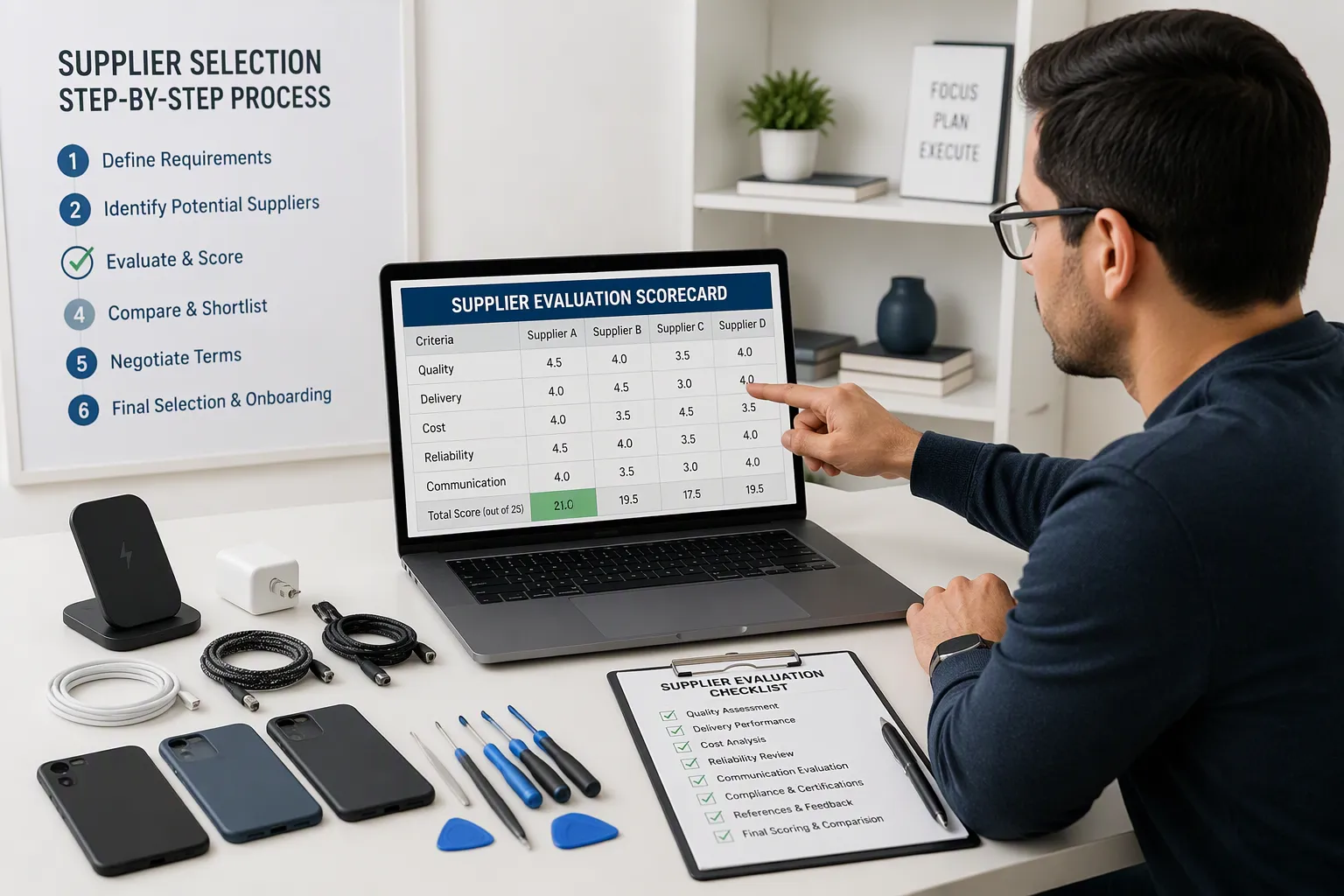
A clear process turns a long supplier search into a short, well-supported decision. Go through the stages below in order. Each stage narrows the field and lowers risk before you commit to large orders.
Write down your buying needs before you contact anyone. Name the product categories, such as chargers, cables, cases, and repair tools. List the models you support and the quality grades you accept. Record your order profile: monthly volume, average order value, MOQ, SKUs per order, peak-season demand, lead time, shipping method, destination countries, packaging, and private-label needs. These details become your filter for every candidate.
Build your candidate list from several sources, not just one. Check manufacturer websites, B2B platforms with independent checks, industry trade shows, and referrals from repair chains and distributors. Targeted search terms such as "phone parts wholesale supplier" also bring up options.
Then compare candidates on a weighted scorecard. A common weighting is product quality at 25%, price competitiveness at 15%, inventory and SKU coverage at 15%, quality control system at 10%, delivery and logistics at 10%, after-sales service at 10%, communication at 5%, export experience at 5%, and payment terms at 5%. Adjust the weights to match your model.
Screening removes weak candidates fast. Confirm full OEM/ODM capability and full-process quality control, from raw material to final packaging. Ask peers about defect rates and delivery consistency. Referrals and verified platforms cut research time and reveal factory-direct access that public listings hide.
Vetting separates real manufacturers from middlemen. Verify ISO 9001 with a current audit report and a live video factory tour. Validate Apple MFi license numbers at mfi.apple.com. Check Qi membership, Qi-ID, and test reports from UL or TÜV. Request SGS and TÜV safety reports and a CE Declaration of Conformity. Claims you cannot verify are a warning sign. Order samples and test them against written specs: scratch resistance, drop protection, button response, output speed, heat levels, and fit and finish. This step confirms compatibility with your target devices before you commit to bulk orders.
Phase | Criteria | Why It Matters |
|---|---|---|
Screening | Verified B2B directories, trade shows, peer referrals | Cuts research time and reveals factory-direct access |
Vetting | ISO 9001, Apple MFi, Qi/Qi2, SGS/TÜV, CE DoC | Distinguishes manufacturers from middlemen |
Vetting | Sample testing against written specs | Reveals actual quality before bulk commitment |
Negotiation | MOQs, pricing, payment terms, Incoterms | Aligns cost with commitment and landed cost |
Negotiation rewards preparation. Compare quotes across suppliers first. Trade higher or longer-term volume for lower MOQs. Swap one-time discounts for loyalty-based pricing and volume rebates. Clarify Incoterms (FOB, CIF, or DDP) and compare quotes only on the same basis. Write down every agreed term in a written contract.
Factory-direct suppliers offer one useful comparison point. Benchmarks such as a 0.3% defect rate, 25–30 day delivery, and national exclusivity show what tight process control looks like. Weigh these against distributors that offer breadth and speed, and against trading companies that offer flexibility. Run basic due diligence on finalists, then narrow to two or three. Look for clear MOQs and clear terms from each. A reliable business partner answers every question directly.
Domestic and overseas partners each have clear trade-offs. The table below shows the main points you should weigh.
Dimension | Domestic distributors | Overseas or factory-direct suppliers |
|---|---|---|
Lead time & responsiveness | Faster restocking; stock is already in the country; returns are simpler | Longer timelines because of production, export, and international shipping |
Communication & time zones | Easier real-time talks; shared language and business customs | Time zone gaps and language differences slow down back-and-forth |
Minimum order quantities | Lower MOQs and mixed-carton ordering that suit smaller retailers and test orders | Larger MOQs or full-carton orders are required for good pricing |
Shipping & import complexity | Simple domestic logistics; no customs clearance or import duties | You must handle international freight, customs paperwork, duties, and border delays |
Pricing potential | Higher per-unit prices but more predictable costs | Lower per-unit prices at scale, offset by freight, duties, and inventory risk |
Read the table as a balance, not a scorecard. Domestic mobile phone accessories distributors win on speed and simplicity. Overseas suppliers win on unit cost once your volume grows. Freight, duties, and inventory risk can erase the pricing gap, so compare landed cost rather than sticker price.
Start where your operation can handle the risk. If you are newer or smaller, starting with solid domestic or regional distributors is often easier than jumping straight into complex overseas arrangements. Move to factory-direct or overseas sourcing only when your volume and experience are strong enough to justify the added risk and operational complexity.
Test orders reveal a lot. Small mixed cartons from local phone accessories distributors let you check sell-through and compatibility before you commit capital. Once a category proves itself, shift that line to an overseas partner and keep the rest local. Many growing retailers run both models side by side, and that mix often serves them well.
If you are newer or smaller, starting with solid domestic or regional distributors is often easier than jumping straight into complex overseas arrangements. Move to factory-direct or overseas sourcing only when your volume and experience are strong enough to justify the added risk and operational complexity.

You can learn a lot from how a candidate presents itself. Strong signs show up before you sign anything. Weak signs also appear early, and they save you from costly mistakes.
An experienced mobile accessories company should show a clear process, proven quality control systems, and customer references. Ask for these items directly. Confirm the supplier's legitimacy and track record before you talk about bulk sourcing. Request certifications, business registrations, and client references from existing customers in your industry. Expect open sharing of manufacturing processes, quality control steps, and compliance with relevant standards. Review business history, customer reviews across multiple platforms, and industry affiliations that show a commitment to professional standards.
Use these checks as a quick screen:
Certifications and business registrations on file
Client references from buyers in your own market
Written quality control procedures
Reviews across several independent platforms
Industry affiliations and trade show history
X·ONE offers a useful example of what these markers look like in practice. The brand was founded in 2009 and has sold over 100 million units. Its products reach more than 60 countries, backed by 180+ patents and awards. A network of over 5,000 resellers spans six continents. Treat figures like these as a template. Look for the same depth of history, reach, and recognition in any candidate you shortlist.
Daily communication tells you how a partner will act after the contract. Reliable mobile phone accessories distributors share stock, quality, and delivery information openly. Simple, transparent pricing builds trust. Clear unit prices, visible volume breaks, and straightforward bundle logic speed up orders. Clear value communication matters too. Product descriptions should cover use cases, durability, compatibility, and performance benefits. This helps you understand why a product costs what it does.
Practice | What It Looks Like | Why It Signals Reliability |
|---|---|---|
Transparent communication | Open sharing of stock, quality, and delivery data | Core value buyers seek in wholesale sourcing |
Simple pricing | Clear unit prices, visible volume breaks, no hidden fees | Clarity builds trust and speeds up orders |
Clear value communication | Descriptions covering use cases, durability, and performance | Lowers resistance and builds confidence |
Reliability over price | Competing on consistency and trust, not lowest price | Buyers pay slightly more for peace of mind |
Watch how fast a candidate aligns cutouts, button access, and model tagging with new handset launches. Check whether it carries certified charging products where speed and safety can be verified. Accurate model tagging and listing quality protect your margin in e-commerce. Precise matching of handset model, material, color, and charging compatibility reduces returns and weak reviews. These habits separate serious mobile phone accessories distributors from casual traders.
A reliable mobile phone accessories distributor earns trust by making clear promises. You should expect written terms on pricing, MOQs, lead times, and warranty handling. Ask for these details before you sign. Vague answers now turn into disputes later.
You should also expect the same quality on every order. Ask for current test reports and certification documents for each product line. Confirm that the distributor tracks defect rates and shares them openly. Strong mobile phone accessories distributors treat quality data as a shared tool, not a secret.
Expect quick communication as well. A serious partner answers questions about stock, shipping, and compatibility within a reasonable time. You should never have to chase basic order updates. Reliable mobile accessories distributors build systems that keep buyers informed without extra effort.
Long-term relationships grow from repeat business, and repeat business grows from products that work. Offer certified products to your buyers. Certified items keep customers coming back because they avoid wasting time and money chasing satisfactory items. Happy buyers may even recommend you to others. That cycle of repeat orders and word-of-mouth is how lasting business relationships form.
Treat every order as a chance to prove consistency. Ship on time, match the approved sample, and resolve claims quickly. These habits turn a first purchase into a standing account. Many phone accessories distributors lose clients through small failures, not big ones. Steady execution protects the relationship.
Share market feedback with your supplier too. Tell them which phone accessories sell fast and which stall. Good accessories distributors use that input to refine assortments. Over time, this two-way exchange makes you a valued partner rather than a transactional buyer.
A low headline price often hides real money. Watch for vague fees in shipping, handling, customs, or processing that quietly eat into your margin. Very high MOQs and forced assortments of slow movers are another trap. So is pressure to prepay large sums quickly. Insist on clear MOQs and a written quote that lists every charge.
Warning Sign to Avoid | |
|---|---|
Pricing and fees | Unrealistically low prices masking hidden fees |
Order commitments | High MOQs, forced assortments, fast prepayment pressure |
Shipping terms | Generic "fast shipping" claims with no timelines or tracking |
Returns and warranty | Missing or unwritten policies for powered items |
Unclear terms cause disputes later. Ask for written defect, return, and warranty policies before you pay. Never pay into personal bank accounts, and accept only verified corporate accounts. A supplier who will not put terms in writing will not honor them.
Weak product quality ruins your reputation faster than any price advantage. Check suppliers, request samples, and run bench checks before signing. Test packaging integrity, labeling, and battery voltage in the 3.80–3.85V range. Putting cost over quality raises return rates and hurts your brand.
Plan lead times with real numbers. Bank wires usually credit within 1–2 business days. Courier air express transit runs 3–7 business days under normal customs conditions. Total turnaround generally lands at 5–9 business days. Lithium battery rules can add 1–2 business days. Restock 2–3 weeks ahead of Chinese New Year and Golden Week. Confirm warranty coverage in writing: 12 months for screens and standard batteries, 30 days for diagnostic zero-cycle batteries. Reliable accessories distributors share these details openly. Strong mobile accessories partners treat steady quality and honest timelines as the base of reliability.
Retail shoppers, not company buyers, set most design and channel trends in the global mobile phone accessories market. What they like decides what sells and how fast it moves. Physical stores still matter a lot here. Offline distribution brought in 69% of total revenue last year, because shoppers want to try products in person before they buy.
New smartphone launches reset demand every year. Each flagship release sets off a fresh wave of accessory buying. The shift toward USB-C and MagSafe ecosystems also keeps replacement demand strong at scale. Protective cases, screen protectors, chargers, wireless charging pads, power banks, and mobile tracking accessories all sell quickly. Smart accessories add another layer, with devices like Apple's next-gen AirTag (January 2026) offering up to 50% longer range and better UWB connectivity. You must refresh your selection all the time to keep up with these cycles. Strong distributors react fast to new device launches and emerging trends, and that speed protects your shelf space.
A balanced mix starts with core daily-use categories: chargers, cables, and wireless audio. These items match what consumers already look for, so they keep repeat business coming. Work with suppliers that offer a wide range, and you can build a complete portfolio instead of a narrow selection. Don't chase every accessory. Focus on fast-moving, high-demand SKUs that sell reliably.
X·ONE shows what a balanced range looks like. The brand covers 15+ product categories across power, protect, portage, and play series. Standing out matters as much as having a wide range. Look for technologies such as DNA Guard 6m drop protection and EnduraClear™ anti-yellow technology. These features give you a story to tell at retail and help keep pricing steady. Reliable distributors pair quality with dependable supply, and that mix keeps your product line profitable over time.
Your decision framework comes down to four moves. Define your needs first. Compare supplier types next. Check the services each one offers. Vet reliability last. Each step narrows the field and lowers your risk.
No single answer fits every business. The best global mobile accessory partner depends on your model and your market. A high-volume factory-direct buyer weighs different factors than a small retailer testing new categories.
Start now with a shortlist and a clear evaluation checklist. Score each candidate against your own priorities. That simple habit turns a crowded market into a confident choice. Then revisit it as your volume grows.
Match the partner type to how much you order. Factory-direct manufacturers work best for buyers who need large volume, control, and customization. Distributors are a good fit for buyers who want a wide range and fast restocking. Trading companies give you flexibility for mixed or smaller orders. Compare the minimum order quantities (MOQs) from each one before you decide.
Check Apple MFi license numbers at mfi.apple.com. Look up Qi membership and test reports for wireless charging. Ask for current SGS and TÜV safety reports and a CE Declaration of Conformity. If you cannot verify a claim, treat it as a warning sign.
Start where your business can handle the risk. Newer or smaller buyers often find domestic or regional distributors easier to work with. Switch to factory-direct or overseas sourcing once your volume and experience are strong enough to justify the extra complexity. Many growing retailers use both models at the same time.
Bank wires usually clear within 1–2 business days. Courier air express takes 3–7 business days when customs runs normally. Total turnaround usually lands at 5–9 business days. Lithium battery rules can add 1–2 business days. Restock 2–3 weeks before Chinese New Year and Golden Week.
Expect support with materials, training, marketing, exhibitions, technical questions, and after-sales service. Confirm warranty terms and return handling in writing before you sign. Ask whether the partner localizes packaging for each market you serve. Strong support keeps compatibility issues from turning into lost sales.
Join X.ONE to access our best-selling original product,and leverage our end to end technical and marketing support to unlock new growth opportunities for your business.
 Material Support
 Training Support
 Marketing Support
 Exhibition Support
 Technical Support
 After Sales Support