
 繁体中文
 Italian
 Spanish
 Thai
 Turkish
 Japanese
 Portuguese
 Russian
 French
 German
 Polish
 Arabic

Oct 10,2026
Which companies provide reliable charging accessories for retailers

A supplier you can't count on can stop your production line, hold up shipments, and break your clients' trust. Missed deadlines cost you money. A damaged reputation costs even more. So how do you find a supplier that comes through every time?
Supplier problems cause 14.51% of all supply chain disruptions, and missing parts are the biggest reason. That number may look small, but just one problem can spread through your whole operation.
This blueprint gives you a useful set of tools. You will learn to set clear numbers to track, check production capacity, and judge delivery abilities. You will also find out how to pick suppliers you can trust and build systems that keep things reliable over time. Stop using trial-and-error. Start building a supply chain that works.
Set clear rules for quality and delivery to choose suppliers you can trust.
Check factories and review their certifications to make sure they can produce what you need.
Look at past delivery records to make sure deliveries are on time.
Compare the full cost of owning something, not just the price of one item, to find real savings.
Use monthly scorecards and vendor-managed inventory to keep things reliable over time.
Begin your search and review of suppliers with clear, factual numbers. Solid data stops guessing and personal opinions. It turns picking a supplier into a choice based on facts. Build your supplier rules around three main parts: quality standards, delivery performance, and financial health along with following the rules. Think of this as your checklist for choosing a supplier. You cannot find a supplier you trust without these standards.
Start with the defect rate. Set a goal below 1% for incoming parts. A supplier that misses this mark causes rework and delays in production. Next, set your on-time delivery rate goal. This number shows how well a supplier meets deadlines. Industry data shows clear performance levels:
OTD Performance | Reliability Interpretation |
|---|---|
Below 90% | Needs investigation; not reliable |
90%–95% | Functional but exceptions visible; moderate reliability |
95%–98% | Strong performance; considered reliable for many operations |
98%+ | Very high reliability; excellent |
Set your lowest on-time delivery at 95%. This mark splits strong suppliers from weak ones. Also track lead time changes. A supplier that delivers within a steady window gives you production schedules you can predict. Add a compliance score to check if the supplier follows rules and contract terms. Track responsiveness to measure how fast they fix problems. Measure average delay to see the usual lag time. These quality metrics form the base for picking the right supplier.
A supplier with great quality but weak finances will let you down in the end. Check their Dun & Bradstreet (D&B) Paydex score and credit risk rating. Review their current ratio and debt-to-equity ratio. These numbers show cash flow health and solvency. Trade credit insurance ratings from agencies like Allianz Trade add another layer of checking.
You also need ESG compliance baselines. Rules like the EU CSRD require standard ESG disclosures with double materiality. Germany's LkSG requires human rights due diligence for companies with 3,000 or more employees. The US UFLPA bans imports tied to forced labor. Your supplier must comply across three areas. Environmental factors include greenhouse gas emissions and waste handling. Social factors cover working hours, wages, and health safety performance. Governance factors include stopping corruption and protecting data privacy.
Beyond fines, non-compliance hurts your brand reputation. Reliable suppliers meet both financial and compliance baselines. These standards complete your supplier selection. Now move forward to check their real production capacity.
You can't judge production capacity and performance from a sales brochure. The only sure way to check what a supplier can really make is through on-site visits or third-party audits. A supplier audit is a careful review of operations, processes, and compliance with contract, regulatory, and quality standards. These audits check manufacturing capabilities, quality control systems, regulatory compliance, workplace conditions, environmental practices, and financial stability. Do this audit before production starts. Checking early lowers operational risks, avoids costly delays, and makes the manufacturing process smoother from day one.
Walk the factory floor yourself or send an independent quality control professional. Start with a pre-audit review of past performance and set the scope. Hold an opening meeting with factory management to make objectives clear. Then tour the facility and review documents. Inspect operations and verify records. Interview employees to confirm conditions from the worker's point of view. Check production lines for equipment that works and stable processes. End with an exit meeting that shares early findings and next steps.
During your visit, confirm equipment is available and in good shape. Ask whether the factory checks equipment on a regular basis and keeps organized maintenance records. Make sure all needed equipment is actually there. A factory missing required equipment may be outsourcing production. Look for on-site lab testing equipment. Check warehouse space and material inventory. Review production samples on site. These steps show whether the supplier can keep steady output as your orders grow.
Assess scalability by looking at facility space planning and site limits. Look for modular designs and layouts that can grow. Map process flow from receiving to subassembly. Find bottlenecks. Evaluate equipment choice and placement for future automation. Check whether single stations can be reconfigured without major rewiring. Ask how a design could be copied across plants using the same core technologies. Confirm that systems talk to existing ERP or MES platforms using open industrial protocols.
Ask the supplier about capacity utilization levels. Warning signs include unclear answers about utilization and failure to measure on-time delivery performance. Find out how much of the supplier's capacity is already promised to your needs. Ask what throughput levels the supplier plans in its schedule and what it has actually shown over the past 12 to 18 months. Check promised lead times against internal cycle times. Large gaps can mean the supplier uses the difference to smooth internal production rather than reliably serving your demand.
Global certifications signal production maturity. When you evaluate a supplier, ask for their ISO certificates and audit reports. Review equipment calibration logs and maintenance records. Check production schedules and output records. Examine HR policies, contracts, and payroll records. Request environmental impact permits and records. The absence of a single document, like a missing calibration log, can reveal deeper systemic gaps.
Review product testing records across several categories. For electronic records, check validated system records, unique credentials, time-synchronized entries, and immutable audit trails. For incoming materials, examine goods receipt records, quarantine status, incoming inspection reports, and supplier CoAs. For in-process controls, review critical parameter checks at defined frequency, SPC control limits, and capability data. For specifications and methods, check controlled SOPs, document control records, and risk-based statistical sampling plans. For instrument control, verify IQ/OQ/PQ records, calibration status, and system suitability records.
These records prove whether a supplier can consistently meet your quality and compliance requirements. Reliable suppliers keep complete, organized documentation. They welcome audits and provide records without hesitation. Use these checks to confirm that your current production capacity and performance expectations align with what the supplier can actually deliver.

Once you know a supplier can make your product, you need to see if they can deliver it on time. Making products is useless if they don't arrive when needed. A supplier that makes great items but has bad shipping can still cause problems. This check looks at three things: delivery time, flexibility, and shipping quality. Use real numbers and past data. A full delivery check tells you which suppliers are good partners and which ones could ruin your delivery reliability.
Actual lead time is receipt date minus purchase order date. Supplier processing time is ship date minus purchase order date. Transit time is receipt date minus ship date. Lead-time deviation is actual lead time minus promised lead time. Positive numbers mean late. Negative numbers mean early. Both cause problems for your schedule.
Assessment Area | Methods |
|---|---|
Delivery Time | Check how steady and predictable lead times are. Look at past on‑time delivery records. See if they can handle rush orders. Think about their ability to fill lots and grow. |
Flexibility | See if they can adapt to changes in order size, how often, or what you need. Check their backup plans for delays. Look at how fast they respond and how they lower risk. |
Shipping Quality | Check their shipping methods, routes, and carriers. Look at packaging, labels, and real‑time tracking. Also check quality checks and how they handle customs. |
How steady lead times are matters just as much as how fast they are on average. A supplier that takes 20 days on average but sometimes 10 and sometimes 30 days causes problems. Find the coefficient of variation (CV is standard deviation divided by mean).
A good rule: standard deviation should be no more than 15 to 20 percent of the average lead time for reliable suppliers. A supplier with an average lead time of 20 days should deliver most orders between 16 and 24 days. More variation means deeper problems that need extra safety stock.
For shipping flexibility, check if they have other routes and live tracking through a transportation management system. Ask if they use data to predict demand. Make sure they improve routes and loads to handle changes in order size. A flexible plan with different shipping options lets you change speed and cost as needs change. These things show the supplier's delivery abilities.
Ask for a full year of delivery records. Figure out the on‑time delivery rate as the percent of items received on or before the promised date. Use a small time window from your contract, like two days early but zero days late. Most companies have rates between 85 and 90 percent. The best ones keep on‑time delivery above 95 percent. Any supplier below 85 percent has big problems.
Break down the data by supplier location, product type, origin area, Incoterm, and shipping mode. Compare normal versus rush shipments. Compare local and overseas suppliers. Create trends over 13 weeks and 12 months for average and P90 lead times and on‑time delivery. Look for seasonal patterns. Compare results to your contract goals and your own company's standards.
Look at delays in each step. Figure out if the delay is from supplier processing, shipping, customs, or your own receiving and quality checks. Use timing differences to find where the hold‑up is. If numbers are worse than similar companies or your contract, take action with supplier improvement or think about a second supplier. A supplier's history of on‑time delivery shows how organized and in control they are. This check helps you pick partners with proven delivery reliability. All these steps help you check a supplier's delivery abilities completely.
To find a supplier for C-parts like fasteners and connectors, you must look past the unit price. One missing bolt can stop an assembly line just like a missing engine block. The real cost is hidden in logistics, quality failures, and inventory carrying expenses. Your supplier selection process must include these hidden factors.
A TCO analysis of 100,000 industrial bolts shows the point. Supplier A quotes $0.05 per unit with a 2% defect rate. Supplier B quotes $0.07 per unit with a 0.01% defect rate. Supplier A looks $2,000 cheaper on paper. But defective bolts create much higher costs from rework and production delays. Your supplier selection criteria must include these hidden categories.
TCO Category | Components Beyond Unit Price |
|---|---|
Acquisition | Unit price, logistics, duties, sourcing costs |
Operating/Usage | Energy, consumables, installation, training |
Quality | Scrap, rework, inspection, warranty, downtime |
Inventory/Working Capital | Safety stock, carrying rate, payment terms |
Risk & Resilience | Disruption costs, dual-sourcing premiums |
End-of-Life | Disposal, recycling, salvage value |
Geographic reach matters when you select the right supplier. Diversified suppliers cut lead times from 100 to 65 days and see 40% fewer disruptions. Vendor-managed inventory programs lower TCO by 20-40%.
Documents tell only part of the story. A site visit shows the real operation. Walk the factory floor and look for Lean practices like 5S. Clean, organized areas show a commitment to quality. Chaotic environments are red flags. Talk to managers and engineers.
Check references from three different industry clients. Ask event-based questions. Did samples match production units? Were delivery promises realistic? How did the supplier communicate during busy periods? A reliable c-part supplier answers with confidence.
Build a supplier selection criteria checklist to evaluate every candidate the same way. Reliable c-part suppliers keep complete records and welcome audits. Dependable suppliers earn trust through transparency. Reliable suppliers reduce your risk.
Identify a reliable and efficient supplier that supports your production schedule. Supplier selection based on TCO, site visits, and reference checks removes costly trial and error.
You chose a supplier with good scores and confirmed skills. Now you need ways to keep delivery on track for many months and years. Watching all the time turns a good supplier into a long-term partner. Make a monthly scorecard that checks key performance indicators. The table below shows the numbers you should look at.
KPI | Formula / Definition | Illustrative Target | Illustrative Weight |
|---|---|---|---|
OTIF (On Time In Full) | Orders Delivered On Time and In Full ÷ Total Orders × 100 | 95%+ | 30% |
Lead-Time Accuracy | Average lead time plus lead-time variance | 95%+ | 15% |
Quality (accepted rate) | Accepted units ÷ total received | 98%+ accepted | 25% |
Cost / Purchase Price Variance | Actual vs. budgeted/contracted price | Within target | 10% |
Responsiveness | Response time within SLA | Within SLA | 10% |
Compliance | Regulatory/contractual/certification adherence | 100% | 10% |
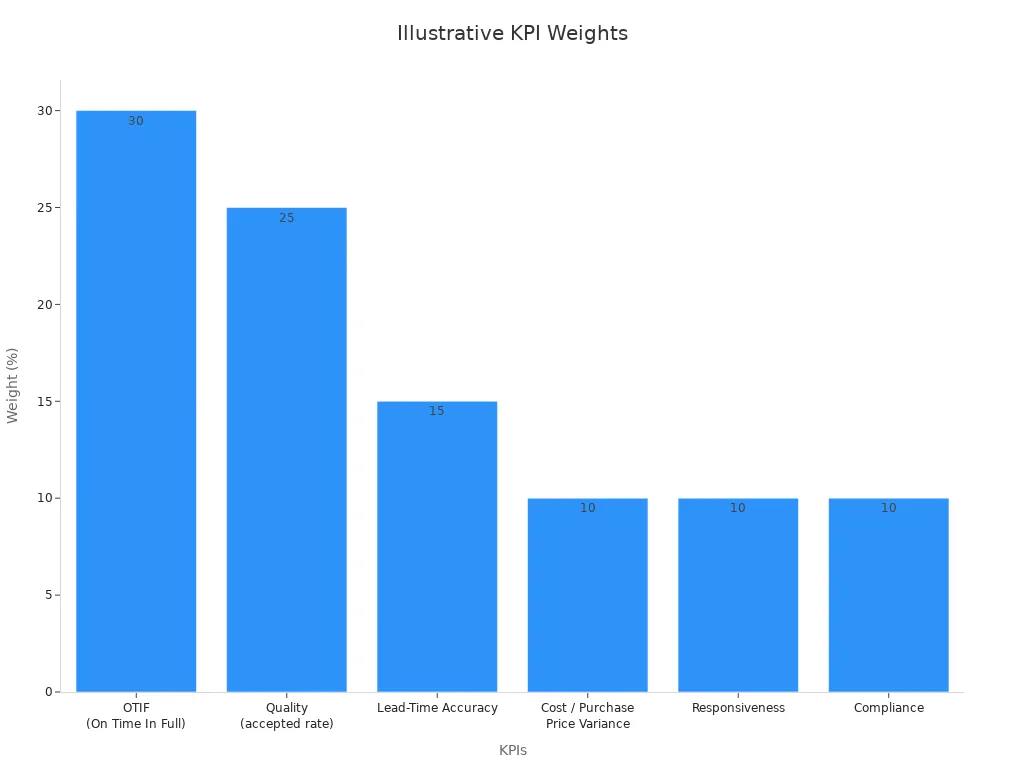
Look at these KPIs as patterns over 12 months, not as single points. Set triggers that flag when something is wrong. Pay attention if OTIF drops below goal, defect rates go up, or lead-time variance gets bigger. Reliable suppliers gain trust by always meeting delivery goals.
VMI moves the stocking job to your supplier. Sales data sets off inventory limits. The supplier looks at demand patterns and stock amounts. Their system makes restocking suggestions. You say yes or change the suggested order. The supplier sends goods with an early shipping note. This process shortens the time between spotting a need and meeting it.
VMI cuts inventory costs and holding costs for both sides. It lowers the chance of running out or having too many of small parts. You get the supplier's know-how and better predictions. To start, you need clear limits, clear jobs, and connected computer systems like ERP or EDI. You also need to set goals and check progress often.
A supplier communication plan says how suppliers tell you about delivery problems. It says who to contact, how fast, and what details to give. Without clear escalation steps, big problems stay unsolved. Make a step-by-step escalation ladder. Level 1 takes care of everyday issues at the working level. Level 2 brings in middle managers. Level 3 gets top managers for serious failures. Level 4 deals with enforcing contracts or finding a new supplier.
Set the action points for escalation and service-level agreements. Mark clear limits, like an SLA break at 75-80% of fix time. Use standard handoff rules and live dashboards to check if rules are followed. For backup plans, approve a second supplier for important parts. Figure out safety stock using how much demand changes, supplier delivery time, and your service goal. Add penalty rules for many delays. These steps keep your work steady and support long-term delivery dependability.
You now have a blueprint you can use again and again to find reliable suppliers. Set clear rules for quality and delivery. Check production capacity using audits and certifications. Judge delivery ability with past on-time rates and steady lead times. Pick suppliers using total cost of ownership, not just unit price. This plan helps you find a supplier you can trust. Good suppliers are open to checks and share their data. Choosing a supplier becomes a skill based on facts, not guessing.
Look at your current supplier list against five points: security and following rules, technical fit, reliability and bounce-back ability, total business value, and a teamwork mindset. Start by checking your current supplier list against these five points. The gap you find today could be the problem you avoid tomorrow.
Set your lowest on-time delivery rate at 95%. Suppliers under 90% need a closer look. The best suppliers stay above 98%. Use these numbers as your starting point for judging suppliers.
Do on-site audits or send outside inspectors. Walk the factory floor. Check if equipment is there, look at maintenance records, and review production samples. Confirm certifications like ISO. Paperwork alone cannot prove capacity.
TCO covers all costs past the unit price: shipping, quality failures, inventory holding, and risk. A low unit price can hide much higher total costs from defects and delays. Always compare TCO, not just price.
Use monthly scorecards that track KPIs like OTIF and quality rate. Set up vendor-managed inventory programs. Make clear escalation plans for problems. Watching things all the time turns a good supplier into a reliable long-term partner.
Join X.ONE to access our best-selling original product,and leverage our end to end technical and marketing support to unlock new growth opportunities for your business.
 Material Support
 Training Support
 Marketing Support
 Exhibition Support
 Technical Support
 After Sales Support