 繁体中文
 Italian
 Spanish
 Thai
 Turkish
 Japanese
 Portuguese
 Russian
 French
 German
 Polish
 Arabic
Sep 24,2026
Reliable Accessories Providers for Smartphone Retailers in 2026
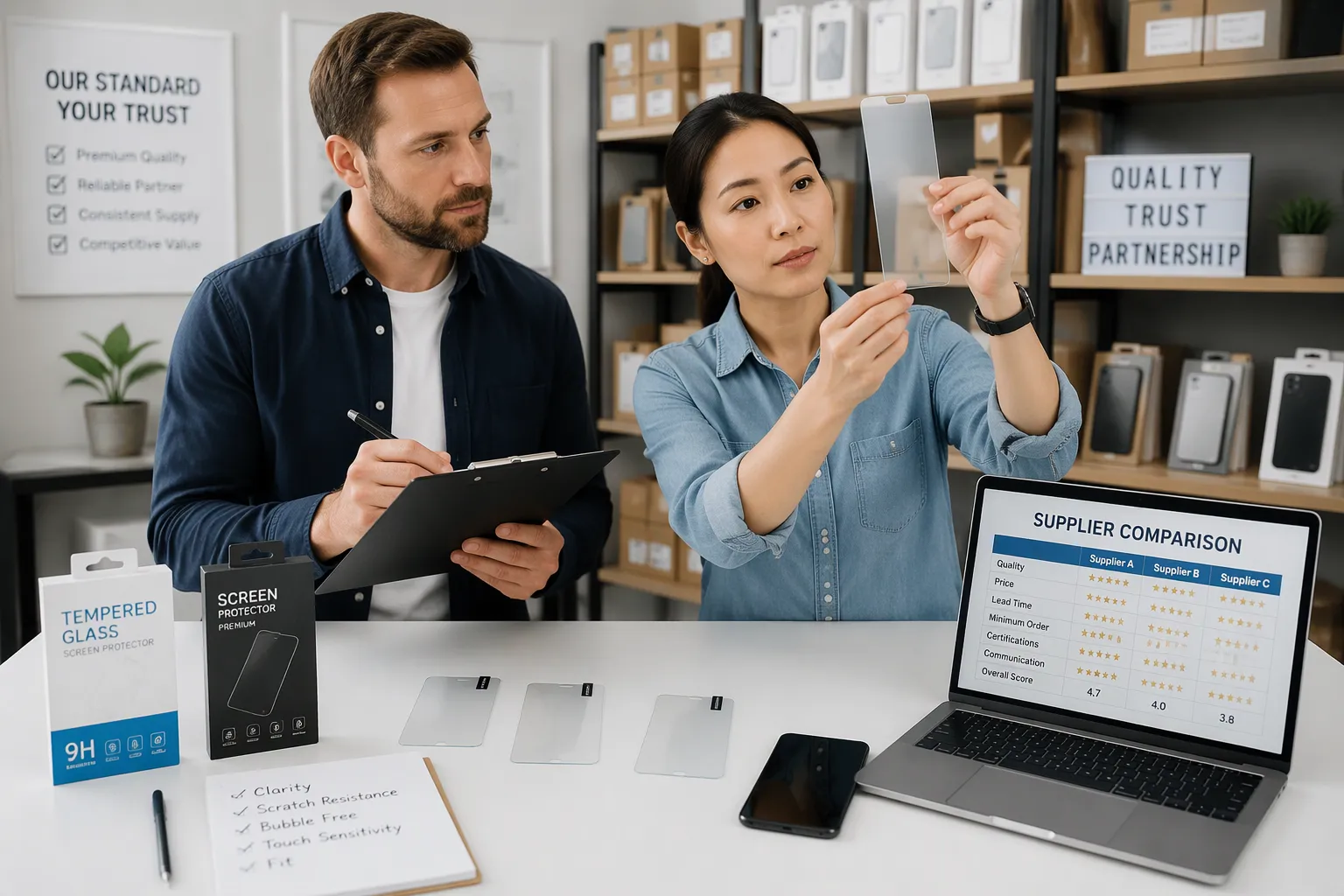
Finding a trusted screen protector supplier is a step-by-step check, not luck and not the lowest price. You set your specs, make a short list of suppliers, test samples, check fit, verify compliance, compare total cost, validate reliability, and formalize agreements. Each step removes risk before you commit money. This guide covers both sourcing routes for your mobile accessories business: direct factories and established brand distributor programs. You will see where each route fits best, so you can choose the one that matches your volume and support needs. Follow the steps in order, and you turn supplier selection from a gamble into a controlled decision.
Set clear specs for your screen protectors before you reach out to suppliers.
Check samples from different batches to make sure the quality stays the same.
Check all compliance papers and certificates to make sure the product is safe.
Figure out the full landed cost so you can compare suppliers fairly.
Put the quality rules and inspection rights in a written agreement.
Your spec sheet starts with picking a material. Each option fits a different customer and device.
Material | Key characteristics | Best fit |
|---|---|---|
TPU film | Soft and flexible, heals light scuffs on its own; covers curved screens; not as clear as glass | Curved displays and full wraparound coverage |
Tempered glass | Heat-treated glass that resists scratches and impact well; stiff and easy to install with alignment trays | Heavy-use devices and buyers who want a premium feel |
Hybrid glass | Thin and bend-resistant, mixing film flexibility with glass traits | Users who want glass clarity plus edge coverage |
Hardness ratings need careful reading. A 9H rating comes from the pencil hardness test, not the Mohs scale, according to Smartish. It means the glass resists a standard 9H drafting pencil. On the Mohs scale, tempered glass sits around 6 or 7, so quartz can still scratch it. Thickness matters too. Most glass protectors fall between 0.2 and 0.33 millimeters, per Smartish. Thicker glass takes impact better but can feel bulky and make touch response dull.
Coatings shape the user experience, so list them in your quality requirements. Common options include:
Oleophobic anti-fingerprint layers that repel oil and make cleaning simple
Anti-glare and anti-reflective coatings that reduce surface reflection
Blue light filters that block some high-energy visible blue light
Hybrid stacks that mix anti-glare, anti-reflective, and hydrophobic layers
Device compatibility closes the spec. Name each exact model and generation, such as Galaxy S23 or Pixel 8, not just a brand family, as DHGate advises. Note curved edges, camera and sensor cutouts, and case-friendly coverage. Generic listings rarely meet the fit demands of a smartphone screen protector line. Build separate specs for flat and curved screens, and plan custom protectors for models with unusual shapes. Every smartphone screen protector you stock should carry its own checked fit data. That habit protects your quality standards and lowers returns.
Trade shows let you visit supplier booths and talk with people in person. Global Sources holds consumer electronics shows in Hong Kong, including an October 2026 event, and these events bring together verified exporters. Regional shows in Asia, Europe, and North America focus on mobile accessories and consumer tech. Asian shows tend to feature factories and OEM/ODM manufacturers, while European and North American shows often include distributors and brand representatives. Walk the floor with your spec sheet in hand and ask direct questions about materials and capacity.
Online platforms widen your reach beyond travel budgets. Compare the main options before you register.
Platform | Verified Supplier Evidence | Buyer Protection | Typical MOQ |
|---|---|---|---|
Alibaba | Verified Supplier tags with third-party checks | Trade Assurance escrow | 50–500 units |
Global Sources | On-site verified exporters; consumer-electronics focus | Verified Supplier Program; limited escrow | 500+ units |
Made-in-China | SGS/Bureau Veritas audited supplier badges | Secured Trading Services escrow | 100–500 units |
Supplier-matching platforms such as Matchory suit buyers who want a shortlist built for them. Smaller orders fit Alibaba's lower minimums, while larger volumes justify the deeper checks on Global Sources.
Peer referrals remain one of the strongest signals in this market. Ask other buyers in cell phone accessories how their suppliers performed on fit, lead time, and defect rates. A good mobile accessories distributor will often share which factories delivered reliably. Trade associations and peer groups carry the same kind of intelligence.
Industry lists add structure to your search. Research firms such as Spherical Insights publish market reports that name active manufacturers. Regional manufacturer directories such as RevenueBase help you locate factories by geography. Treat every list as a starting point, not a verdict. Each channel fits a different business size and order volume, so match the channel to your stage. A small retailer can start with referrals and B2B platforms. A larger distributor of mobile accessories can invest in trade show travel and paid matching services. The right kind of mobile accessory distributors uses several channels at once and cross-checks the results. Whether you seek the best cell phone accessories distributor or a good mobile accessories distributor, verify claims against samples and documents before you sign.
A datasheet should list the material, thickness, hardness test method, coating type, and light transmission. Read it with doubt. Vague phrases like "military grade" or "unbreakable" tell you nothing. Ask for the test method behind each claim. A 9H rating means little without the pencil grade and load used.
Third-party testing adds real value. TÜV states that a product certificate confirms a product meets defined criteria and safety aspects. It also says recognized test marks give buyers visible proof of quality from an independent party. TÜV also reports that almost 90% of surveyed buyers prefer manufacturer claims to be neutrally reviewed and confirmed. Use audit reports as a filter, too.
Credential | What it indicates |
|---|---|
TÜV Rheinland and SGS on-site audits | Inspectors check plant size, machine counts, cleanroom standards, and employee numbers, which confirms real manufacturing ownership |
Third-party factory audit reports | Reports from TÜV Rheinland or SGS, accredited ISO 9001 certificates with verifiable registry numbers, and formal invention patents confirm authentic manufacturing |
Run your own tests before you commit to volume. Order samples of every smartphone screen protector model you plan to stock. Then follow a simple routine.
Scratch test: drag a coin and a key across the surface with firm pressure, then check for marks.
Clarity check: place the protector on a screen and compare text sharpness against bare glass.
Touch test: type, swipe, and use the fingerprint sensor to confirm response.
Adhesion test: apply the protector, wait, then press the edges for lifting or bubbles.
Repeat each test on several units. One good sample proves little. Results that stay the same across a batch tell you the smartphone screen protector line holds its quality. Test tempered glass and film samples the same way, and log every result. These records give you leverage in later talks over screen protectors.
Most returns come from fit problems, so test every model before you stock it. Start with the cutouts. A Dynamic Island opening must sit centered over the front camera and sensor area, not just somewhere near the top, as Smartish notes. An offset opening can cover part of the sensor. It can also push the adhesive across a border it was not shaped to follow. Check these points on each smartphone screen protector:
Model verification and front-glass measurements
Sensor and camera placement
Case-friendly spacing around the perimeter
Rounded corners and bezel thickness
Case clearance needs its own test. Install the glass without the case, confirm the border sits flat, then add the case and watch the corners. A lift that shows up only after the case goes on points to bumper pressure. Case-friendly glass usually leaves a narrow margin around the display, and Smartish describes this as roughly a 0.1mm tolerance. Rokform reports that over 80% of screen cracks start from edge impacts, so a lifted edge is a real risk, not a cosmetic flaw. Curved screens add another layer. A protector built for a flat screen will fail on a 2.5D or 3D curve, and cheap film lifts at the edges and collects dust. Confirm compatibility for each curve type before you order.
The kit decides whether customers install the smartphone screen protector cleanly on the first try. Compare the main kit types before you choose.
Kit Type | Components | When It Matters |
|---|---|---|
Basic tool kit | Cloth, cleaning solution, dust stickers, squeegee | Flat protectors on older devices |
Auto-alignment tray | Fixed tray holding phone and protector in registration | Flagship phones; cuts most centering errors |
Dust-free chamber | Sealed tray with static dust-lift layers | Dry climates and homes with pets |
Alibaba's buying guide sets a minimum credible kit as one tempered glass film plus a cleaning kit plus installation accessories. Retail packaging must sell in seconds, so use a clear window, a short benefit line, and a model-clear label. A dust-free chamber set gives a steady first-try install, while cloth-and-squeegee kits depend on user skill. Hold every smartphone screen protector to that standard, and check that the packaging protects the glass in transit. Strong quality here lowers replacement costs and protects your margins.
Ask for a set of documents before you approve any supplier. Get a signed REACH/SVHC declaration that matches the exact material and the current Candidate List date. Add safety data sheets for adhesives, coatings, and cleaning fluids in the installation kit. Ask for RoHS declarations for the smartphone screen protector and its electronic accessories, and keep packaging evidence in a separate file. A risk-based evidence ladder keeps the file defensible, as Leeyin Acoustic explains:
Level one covers supplier identity and formulation evidence.
Level two covers documentary risk assessment.
Level three covers targeted or full analytical screening.
Move to level three when the formulation is unknown, the supplier evidence is weak, or a customer demands independent verification.
Treat each document as a claim about one material. A report for one component does not cover another. Leeyin Acoustic says it plainly: "The report must match the actual material or packaging component. A result for brown corrugated board does not automatically cover a printed label, hot-melt adhesive, plastic bag or foam insert." Use the same logic for every smartphone screen protector in your range. Glass, adhesive, coating, and packaging each need their own paper trail.
Check each certificate at the source. Look up the issuer, confirm the report number in the issuer's registry, and check the certificate's scope against the product you ordered. A certificate for a different model or material proves nothing about your smartphone screen protector. Match the model name, material, and test standard line by line.
Watch for expired documents and copied logos. Ask the supplier for a fresh copy with a visible issue date. Cross-check the certificate holder's name against the factory name on the business license. When the names differ, ask for the relationship in writing. Keep every verified document in a compliance file for each smartphone screen protector you stock. This file supports your compatibility claims at retail and answers buyer questions fast.
The unit price is just one part of the total cost. ProPacks lists tooling and setup charges, minimum order quantities, payment terms, and FOB terms as separate items. A quote marked FOB Factory covers production only. Freight, insurance, and delivery to your warehouse are your responsibility. ProPacks also warns that tooling charges can reach 20 to 40 percent of a first order under 5,000 units, and setup fees come back with every production run.
Payment terms affect your cash flow. Common structures include Net 30, T/T 30/70, and 50/50, and overseas suppliers almost always require a deposit. SourceReady adds packaging, customs brokerage, inspection and testing, warehousing, financing, and quality costs to the list. A supplier quoting $4.50 per unit is not always cheaper than one quoting $4.80, because these costs can flip the comparison. Ask each candidate for a full breakdown before you rank quotes for your screen protectors.
Build a landed-cost sheet for every smartphone screen protector you plan to stock. Add base cost, freight, duties, brokerage, insurance, and inspection fees. Fishbowl Inventory notes that landed cost often adds 15 to 30 percent on top of the purchase price for importers. Bizowie shows the effect: a $19 overseas quote with $3.80 freight, $1.50 duties, $0.40 brokerage, and $0.25 insurance lands at $24.95, close to a $28 domestic price.
Then set your selling price. Fishbowl Inventory gives the formula: selling price = total landed cost ÷ (1 – desired margin). A $10 landed cost at a 40 percent margin becomes $16.67. Markup and margin are not the same, as the Fishbowl Inventory table shows.
Markup % | Margin % |
|---|---|
25% | 20% |
50% | 33.3% |
100% | 50% |
150% | 60% |
Use this math across tiers. Retail absorbs channel fees, wholesale works on volume discounts, and distributor pricing depends on payment terms. Run the numbers for tempered glass protectors at each tier before you commit. The same rule applies to every smartphone screen protector, tempered glass line, and bundle of screen protectors you source.
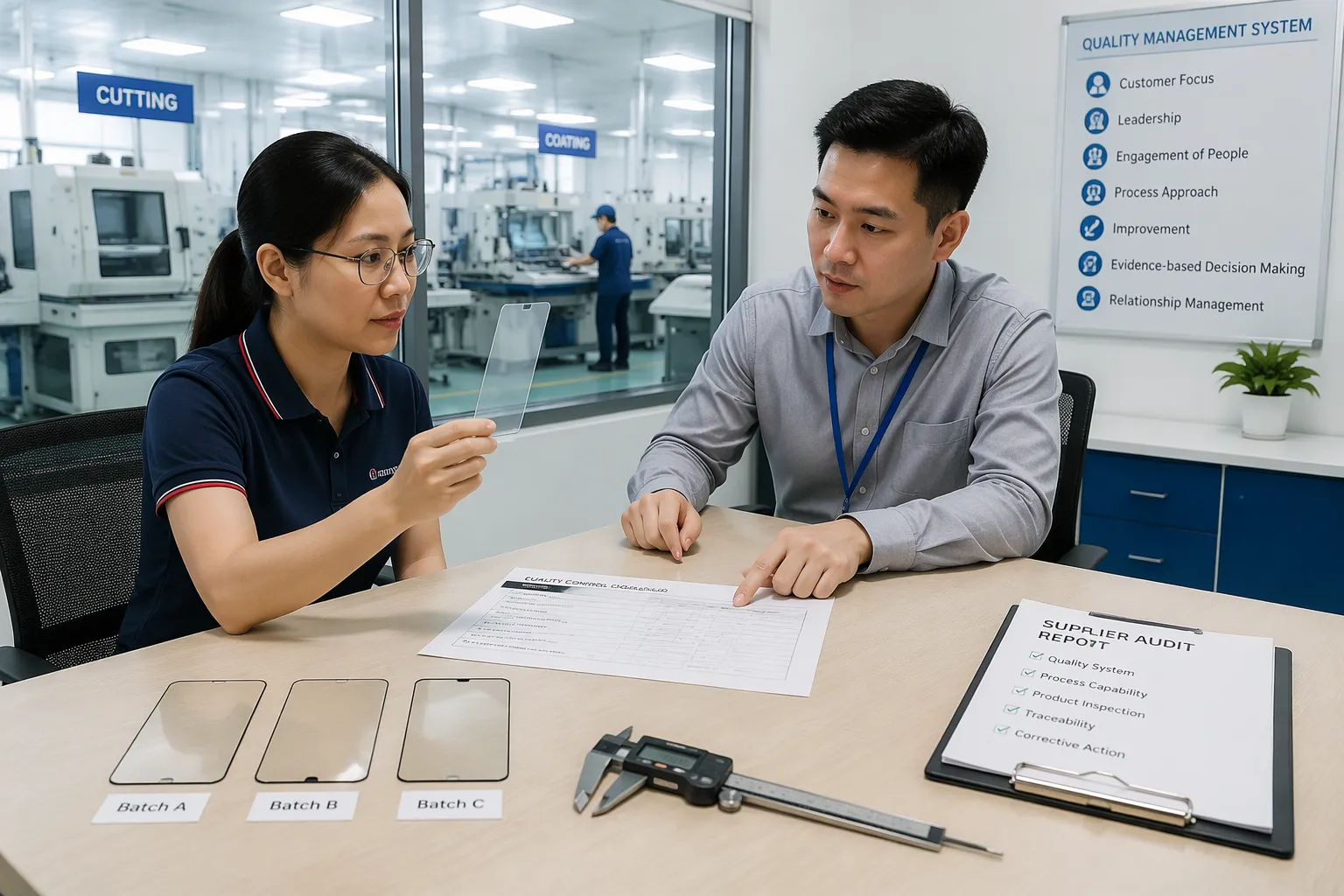
An audit turns promises into facts you can see for yourself. You have four practical options, and each one fits a different order size and risk level.
Audit Option | Cost | Best For | Weakness |
|---|---|---|---|
In-person audit | $800–$2,500 | Large orders and new factories | Travel time and scheduling |
Virtual or video audit | $300–$700 | Follow-ups and mid-size orders of $5,000–$20,000 | The factory controls the camera |
Self-audit checklist | Travel and labor only | Experienced importers combining a trip with a trade show | Uncalibrated and subjective |
Document-based verification | $299–$500 | Pre-qualification and orders below $10,000 | Cannot see equipment or count workers |
ChineseCheck reports that most experienced buyers use a mix: document-based verification first, then an on-site audit only for orders above roughly $10,000 or in high-risk categories. A self-assessment questionnaire the factory fills in itself is worth about what it costs, per ChineseCheck. Pair any audit with a Quality Management System review, which AQI Service describes as checking that documented processes actually run on the floor rather than sit filed away. Add a process and technical capability review to confirm the machines can hold your tolerances.
ISO 9001 proves a factory keeps a documented quality system. It does not prove your smartphone screen protector meets your spec, and it does not replace sample testing. Treat the certificate as one filter among several.
Ask for proof of output, not just a verbal claim. Request photos or videos of the coating, cutting, inspection, and packaging lines, as Okhope Case advises. Confirm the supplier accepts small trial orders and custom packaging. Ask for three samples from different batches, then measure thickness, check for bubbles, and apply each protector yourself. One sample never tells the full story.
Response speed reveals a lot. Send a technical question and watch how fast and how accurately the supplier replies. Vague answers often signal costly delays later. Compare delivery records, replacement policies, and written specifications across candidates.
Reviews add a second signal. Read Trustpilot, Google Reviews, and supplier directory ratings, and weigh them as one input rather than a verdict. Ask for references from other customers in your region and order size. A good mobile accessories distributor will share which factories performed well. That kind of referral helps you judge the reputation of a candidate before you commit. A reputed distributor earns that standing through consistent output, so check whether the supplier's quality record matches its marketing. Every trusted screen protector supplier should welcome a capacity check, and every trusted screen protector supplier should supply batch records on request. Verify that the factory can hold consistent quality during larger orders, and confirm lead times in writing. Solid checks here protect your margins and support reliable screen protection for your customers. Stock screen protectors only after these checks pass, and treat each smartphone screen protector order as a fresh test of the relationship.
Both routes can work well. The right choice depends on your order volume, your team's capacity, and the support you need.
Factor | Direct factory | Brand partner program |
|---|---|---|
Unit cost at volume | Lower | Higher |
Vetting work | Falls on you | Handled by the brand |
Marketing and training | You build it | Often included |
A factory gives you raw-material access and steady mass production. You can specify glass, coatings, and packaging down to the detail. Unit cost drops at volume, and you control the supply chain. The trade-off is vetting work. You run the audits, sample tests, and compliance checks yourself. This route fits a mobile accessories distributor with sourcing experience and steady volume. A distributor of cell phone accessories who orders in large batches will capture the cost savings. A good mobile accessories distributor pairs factory sourcing with a strict inspection routine.
A brand program gives you a proven product line and partner support. X·ONE, founded in 2009, has sold over 100 million units across more than 60 countries. The brand holds 180+ patents and carries MFi, Qi, SGS, and TÜV certifications. Partners get help with materials, training, marketing, exhibitions, technical issues, and after-sales service. Other established players include ZAGG, Belkin, Corning, and Devia Global. This route suits a cell phone accessory distributor who wants fast market entry. A reputed distributor of mobile accessories gains brand recognition and proven quality. A good mobile phone accessory distributor still checks samples and terms. A cell phone accessories distributor should weigh brand reputation against margin. A mobile phone accessory distributor with limited sourcing staff benefits most. A reputed distributor builds trust on the brand's track record. The best cell phone accessories distributor matches the program to local demand. A distributor of mobile accessories can scale faster with this support. A mobile accessories distributor with strong retail ties fits here. A cell phone accessories distributor serving phone accessories shops gains ready demand. A mobile accessories distributor should confirm territory terms early. A reputed distributor of mobile accessories reviews the contract before signing.
A written quality clause keeps both sides safe. Begin by defining what counts as a defect. Tenwin Glass suggests sorting defects into critical, major, and minor groups with clear, measurable limits. "Bad edge" means nothing in an argument. "Edge chip longer than 0.3 mm or deeper than one-third of the glass thickness" gives you a standard you can actually test.
Class | Examples on a glass protector | Typical acceptance |
|---|---|---|
Critical | Through-crack; unstrengthened glass; sensor opening fully blocked; sharp edge that cuts | Zero — reject the lot |
Major | Edge chip above the agreed size; bubble in the active area; border overlap; low transmittance; coating missing | AQL 0.65–1.0 |
Minor | Slight border colour shift; inclusion at the extreme edge; retail box scuff | AQL 2.5–4.0 |
Put the standard, inspection level, and AQL values in the contract. Tenwin Glass names ISO 2859-1 as the accepted framework, published in the United States as ANSI/ASQ Z1.4, with General Inspection Level II as the normal starting point for accessory shipments. Say when inspection happens, who does it, and the fix for each failure class. Keep signed samples for at least 90 days, per Tenwin Glass, and hold both sides to the same retention period.
Start with a trial order before you commit to volume. A small batch of screen protectors lets you test fit, clarity, and adhesion on several units. Write down every result and compare it to your spec sheet.
Set scaling terms in the same agreement. Fix reorder quantities, lead times, and price breaks at each volume tier. Talk about exclusivity early if you want territory protection. Make sure the smartphone screen protector you approve in the trial matches the production version. Check compatibility claims against the final packaging. A clear trial clause and written scaling terms turn a good sample into a steady supply line for your smartphone screen protector range. Look over the quality terms once more before signing, and keep your smartphone screen protector records on file.
You now have a process you can repeat. A trusted screen protector supplier earns that status through documents, samples, and audits, not through promises or a low quote. Run the same eight steps for every candidate:
Define specs.
Shortlist suppliers.
Test samples.
Check fit.
Verify compliance.
Compare landed cost.
Audit the factory.
Lock in quality clauses.
Then match the route to your business. Choose direct factory sourcing for volume and control, or a brand partner program for built-in support. Either path works for a mobile accessories, cell phone accessories, or phone accessories operation. Start with a small trial order, check the results, and grow with confidence.
Test several units from different production batches, not just one perfect sample. Measure the thickness, check for bubbles, and apply each protector yourself. If results stay the same across the batch, the line holds its quality. Write down every result for later talks.
Start with a REACH/SVHC declaration, RoHS declarations, and safety data sheets for adhesives, coatings, and cleaning fluids. Ask for test reports that match the exact material and model. Keep each checked document in a compliance file for every screen protector you stock.
Look up the issuer, confirm the report number in the issuer's registry, and match the certificate's scope to the product you ordered. Check the issue date and compare the certificate holder's name against the factory business license. Ask for a written explanation when the names differ.
Define defect classes, inspection level, and AQL values in writing. Fix reorder quantities, lead times, and price breaks at each volume tier. Keep signed samples for at least 90 days. Confirm the production version matches the approved trial sample before you scale.
Match the route to your volume and support needs. Choose direct factory sourcing for lower unit cost at volume and full control, but accept more vetting work. Choose a brand program such as X·ONE for proven products and partner support. Start small either way.
Join X.ONE to access our best-selling original product,and leverage our end to end technical and marketing support to unlock new growth opportunities for your business.
 Material Support
 Training Support
 Marketing Support
 Exhibition Support
 Technical Support
 After Sales Support