 繁体中文
 Italian
 Spanish
 Thai
 Turkish
 Japanese
 Portuguese
 Russian
 French
 German
 Polish
 Arabic
Sep 10,2026
Top Customized Phone Accessories Companies with Quality Assurance in 2026
What makes a professional supplier different from a trading company that just resells? You can see the answer in paperwork, process control, and who takes responsibility. As one manufacturing guide says:
Quality control is one of the biggest differences between professional factories and trading companies.
You can use the same test on any supplier you are considering. Check each one against four things:
Technical performance
Application fit
Regulatory compliance
Cost
This post gives you specific questions to ask and warning signs to watch for at each stage. Use them to judge whether a supplier really controls quality for its screen protectors, or just moves boxes.
Look at the test reports for hardness, clarity, and coating durability.
Ask for samples to test the fit, touch response, and fingerprint performance.
Check the ISO 9001, RoHS, and REACH certificates with the group that issued them.
Compare the full cost, including defect rates and warranty shipping.
Pick a supplier that gives you written proof, not just sales talk.
Many buyers get confused by the 9H claim on the package. This rating comes from the pencil hardness test, not the Mohs scale. Pencil leads go from 9B (softest) to 9H (hardest), and a 9H score means the surface resists scratches from the hardest pencil. ASTM D3363, first published in 1974 and revised in 2022, sets the method: technicians drag leads across the surface at a 45-degree angle under set pressure. ISO 15184 describes the same European method. On the Mohs scale, tempered glass usually sits around 7, so quartz and sand can still scratch it. All tempered glass passes the 9H test, which makes the claim almost meaningless without paperwork. Ask for SGS or TÜV test reports, and treat vague hardness claims with no paperwork as a red flag.
Thickness and impact resistance work together. Good glass protectors measure around 0.3 mm, according to Smartish, and this range balances drop performance with touch sensitivity. Thicker glass can block or distort the signal of in-display ultrasonic fingerprint sensors, per Dodo Case. A protector absorbs impact force and shatters instead of your phone's display. A clear, low-branding protector often beats ultra-thick glass because it passes touch input cleanly. Tempered glass goes through heating and cooling that makes it five times stronger than plastic, Rokform notes.
Light transmission separates good glass from mediocre glass. Alibaba's buying guide recommends at least 91.5 percent transmittance measured at 550 nm, checked by third-party lab reports rather than marketing claims. Glossy finishes pass light straight through and keep native sharpness, while matte textures spread light and soften text edges. Glass quality also depends on a clean, even surface free of scratches, bubbles, and distortion.
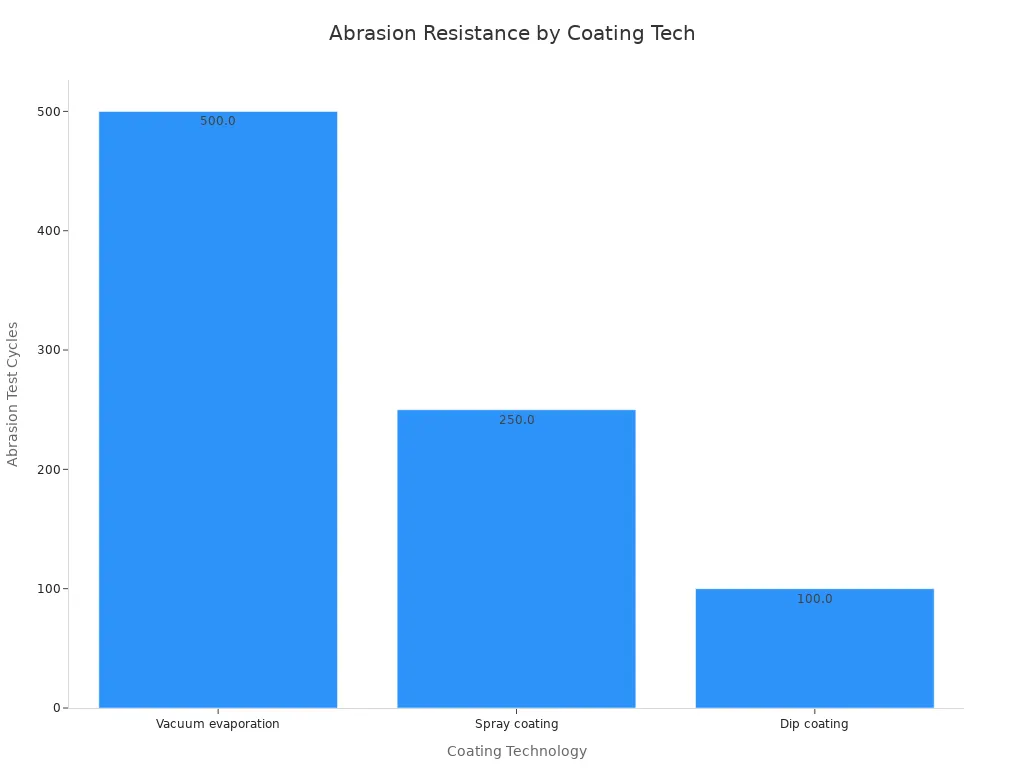
Surface coating decides fingerprint resistance. Vacuum evaporation adds an anti-fingerprint layer at the molecular level, reaching a water contact angle of 110 to 120 degrees and passing 500 cycles of steel wool abrasion, according to Yizhen Films. Spray coating drops clearly after 200 to 300 cycles, and dip coating fails before 100. A contact angle below 90 degrees means no effective oleophobic layer exists. Yizhen Films also reports that a good coating costs 15 to 40 RMB in materials and processing alone. The chart below, published by Yizhen Films, compares abrasion test cycles across these coating technologies.
Coatings wear off over several months of use, so durability matters as much as initial performance. A professional tempered glass manufacturer documents coating performance with lab data. Ask suppliers these questions: Can you share SGS or TÜV test results? What is the measured light transmission? Which coating technology do you use, and what abrasion cycle count does it survive? Strong answers show production quality. Weak answers show a reseller.
Edge labels confuse many buyers. The 3D label means the glass is bent on both sides to follow a curved screen, according to The7Electronics. Higher labels mean little beyond marketing. The same source says that 4D, 5D, 9D, and 12D "don't make any sense so far," and Alibaba calls 6D an old term for small coverage claims. Treat every D label as a description of edge curve and coverage, not a quality grade.
Fit starts with exact device measurements. Ask your supplier for the real outline, cutouts, and printed border, then compare them with the device. Rokform notes that most manufacturers leave a 1-2mm gap around the edge, and many "full coverage" products hide a 0.5-1mm gap in the fine print. That gap is where cracks start during corner impacts. Choose glossy or matte finishes based on what end users like, and confirm the finish on the sample. A screen protector manufacturer with real customization ability will match your device list exactly.
Adhesive decides whether a protector stays flat. High-quality adhesive supports full-coverage bonding and bubble-free application, as Vicround describes for full-coverage tempered glass screen protectors. Weak adhesive lifts at the edges, collects dust, and fails early. Ask about the adhesive type and request installed photos under raking light, because gaps show clearly at that angle.
Test before you commit. A reliable screen protector manufacturer supplies samples so you can check edge fit, touch response, fingerprint performance, and coating before a bulk order. Viascreens notes that samples let buyers feel clarity and texture firsthand. Run the same checks across several units to confirm consistency. A lifetime warranty also shows confidence in durability. Whether you source from a screen protector oem factory or a screen protector manufacturer in china, insist on samples and written warranty terms first.
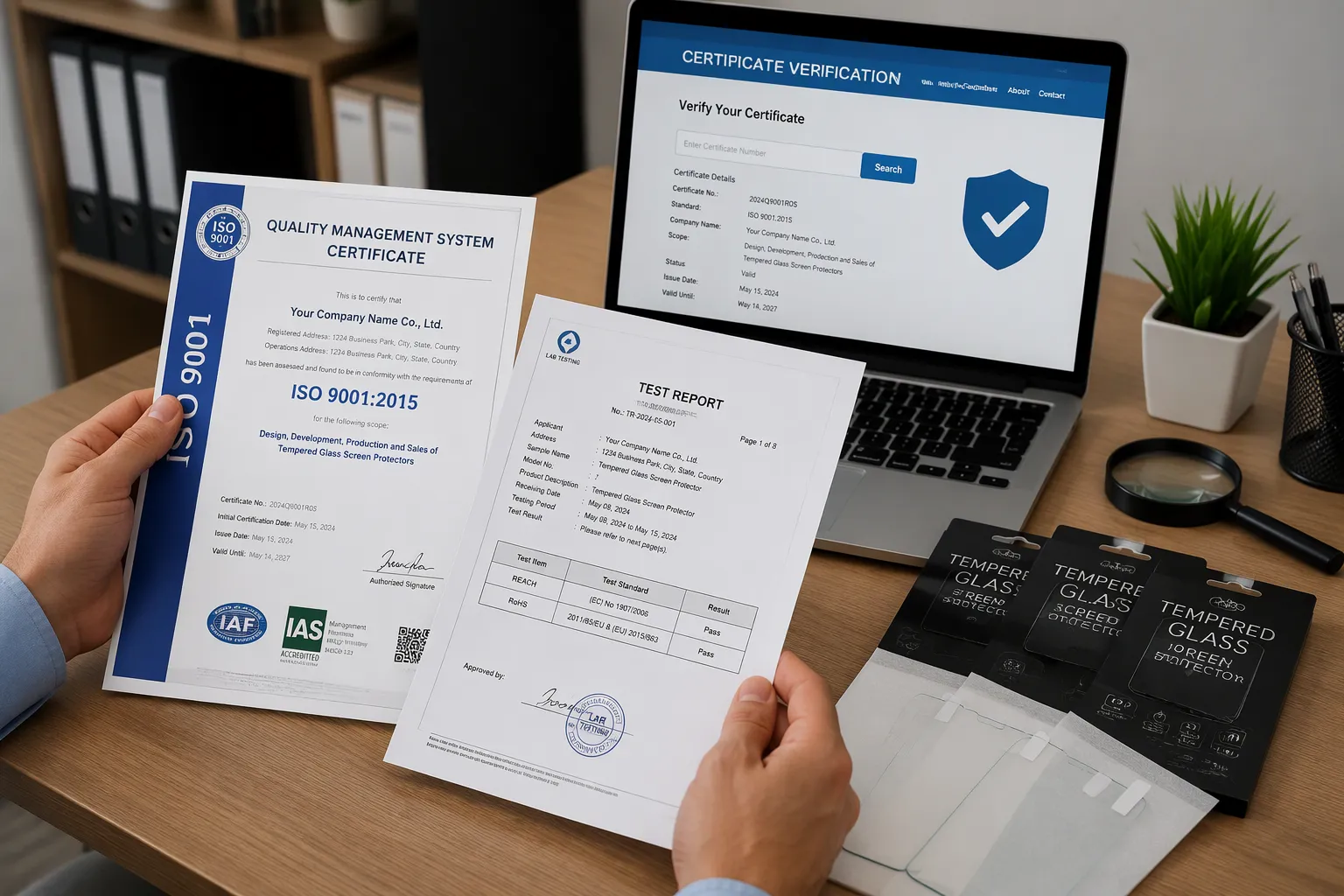
Start with three papers. ISO 9001 covers how a supplier manages quality. RoHS limits harmful substances in electrical products. REACH deals with chemical safety across the European market. Each one answers a different question about how a screen protector manufacturer controls its process.
Read the scope, not just the logo. A certificate only counts for the activities it names. One manufacturer's ISO 9001:2015 certificate, issued by CTI Certification, covers the activities listed in its certified scope. Another supplier states the point plainly:
The scope of this certification explicitly covers the manufacturing of screen protectors, validating the company's end-to-end processes from design and production to final inspection.
That difference matters. A trading company can hold ISO 9001 for distribution and still outsource every sheet of tempered glass. Ask for the scope statement in writing.
Test reports need the same careful check. A tempered glass kit tested by SGS on 22 Dec 2023 produced a REACH report that flagged further assessment needed, with TPO recorded at 0.647% in a mixed sample. A mixed-sample result does not show the concentration in each individual layer or component, and you should not call it an overall pass. The companion RoHS report from the same SGS date covers a tested sample within a stated scope. These documents do not prove blanket U.S. market approval. Confirm the current sample and formulation before you rely on either one.
Do not accept a scanned PDF as proof. Contact the issuing body directly and confirm the certificate number, the scope, and the validity dates. Certificate databases from certification bodies let you check status in minutes. A supplier with nothing to hide will welcome the call.
Then look at the supplier's track record. A reliable screen protector manufacturer earns trust through evidence you can check:
Checking former customers: research reviews, ratings, and testimonials. Positive feedback from other businesses shows the manufacturer meets customer expectations.
Proven specialization: confirm strict quality control, proper adhesive strength, scratch resistance, anti-fingerprint coatings, and anti-glare properties.
Manufacturing capacity and lead time: enough capacity for large orders and small custom runs, with quick turnaround.
Customization options: different sizes, shapes, and features such as blue light filtering or privacy protection.
Warranty and after-sales support: fast responses to defects and complaints, with real solutions.
References in similar applications: compare offerings against the same technical requirements and test how they respond to unusual conditions.
Supplier audit: investigate actual control processes and corrective-action records rather than marketing certificates without context.
X·ONE shows what full compliance looks like. The brand holds Apple MFi approval and Qi wireless certification, and SGS and TÜV test its products against global standards. That combination supports reliable manufacturing and consistent production quality across every batch. Whether you source from a tempered glass production factory, a tempered glass factory in china, or a screen protector manufacturer in china, demand the same proof. A professional supplier documents durability and protection claims with certificates you can verify, not slogans you must trust.
Suppliers give prices in different ways. Coeven describes a common setup: factory pricing for classified screen guards within 24 hours of your inquiry, retail packaging priced on its own for different sales channels, and shipping suggested by order volume and weight. MOQ shapes your first order. Coeven keeps 25pcs per model for regular stock. Accio reports that manufacturers usually ask for 5,000-10,000 units, while trading companies ask for 1,000-3,000 units. A low MOQ protects your cash flow on a first order. A high MOQ lowers the unit price but ties up your money.
Unit price alone can fool you. Rokform's framework adds purchase frequency, shipping on warranty claims, and installation failures to the starting price. Its 24-month comparison shows budget screen protectors at $10 with a 35% installation failure rate cost $80 total, or $3.33 monthly. Mid-range screen protectors at $25 with an installation frame land near $82.50, or $3.44 monthly. Premium screen protectors at $45 reach about $95, or $3.96 monthly. Rokform notes that monthly costs cluster within a $0.60 range. Defect rates matter too: Rokform puts established brands at 2-3% out of the box and budget brands at 8-12%. Warranty shipping runs $5-10 each direction, so Rokform advises skipping claims on screen protectors under $25.
Compare suppliers on quality, price, product variety, and customization options together. A professional supplier with oem and odm customization capability and flexible screen protector customization solutions earns its price premium. Partner programs offset upfront differences. X·ONE supports partners with material, training, marketing, exhibition, technical, and after-sales support.
Judge a screen protector factory on more than price. Ask about tempered glass grade, glass thickness, and quality control records. A screen protector manufacturer in china with flexible oem/odm support and one-stop private-label branding support reduces your sourcing risk. Strong customization capability and customization flexibility let you order oem custom protectors that fit your market. Reliable protection and consistent quality across tempered glass batches protect your brand reputation. Every supplier should document glass quality and batch testing for its screen protectors.
You now have a repeatable framework: technical performance, application fit, regulatory compliance, and cost. A professional supplier meets all four. Never optimize for one factor alone.
A reliable screen protector manufacturer proves tempered glass screen protectors with test reports, device fit, and verified certificates. Cheap screen protectors hide defects that raise your total cost. Consistent quality across glass batches keeps your screen protectors reliable.
Take one practical step next. Request samples and test reports from each screen protector manufacturer on your shortlist. Test fit, clarity, and durability before a bulk order. That habit separates quality suppliers from resellers. It also secures reliable screen protection and lasting protection for every device you sell.
The 9H score comes from the pencil hardness test under ASTM D3363. It shows the surface resists scratches from the hardest pencil lead, not from quartz or sand. Almost all tempered glass passes this test. Ask for SGS or TÜV reports instead of trusting the package label.
Aim for around 0.3 mm. This range balances impact resistance with touch sensitivity. Thicker glass can distort signals for in-display fingerprint sensors. A clear, low-branding protector often outperforms ultra-thick glass. Confirm the thickness in writing before you order.
No. These labels describe edge curvature and coverage, not a grade. Higher numbers carry no technical meaning. Check the actual outline, cutouts, and border against the device. Watch for hidden gaps of 0.5-1 mm under "full coverage" claims.
Request ISO 9001, RoHS, and REACH documents. Read the scope statement, not just the logo. Contact the issuing body to confirm certificate numbers and validity dates. A professional supplier welcomes that call. X·ONE, for example, holds Apple MFi approval, Qi wireless certification, and SGS and TÜV testing.
Add defect rates, replacement costs, packaging, freight, and after-sales support to the unit price. Budget screen protectors carry higher out-of-box failure rates. Compare quality, price, product variety, and customization together. Partner support programs from established brands can offset upfront differences. A screen protector manufacturer in china with flexible OEM support lowers your sourcing risk.
Join X.ONE to access our best-selling original product,and leverage our end to end technical and marketing support to unlock new growth opportunities for your business.
 Material Support
 Training Support
 Marketing Support
 Exhibition Support
 Technical Support
 After Sales Support