 繁体中文
 Italian
 Spanish
 Thai
 Turkish
 Japanese
 Portuguese
 Russian
 French
 German
 Polish
 Arabic

Oct 15,2026
Top 10 Best Premium Accessory Suppliers for Online Marketplaces in 2026
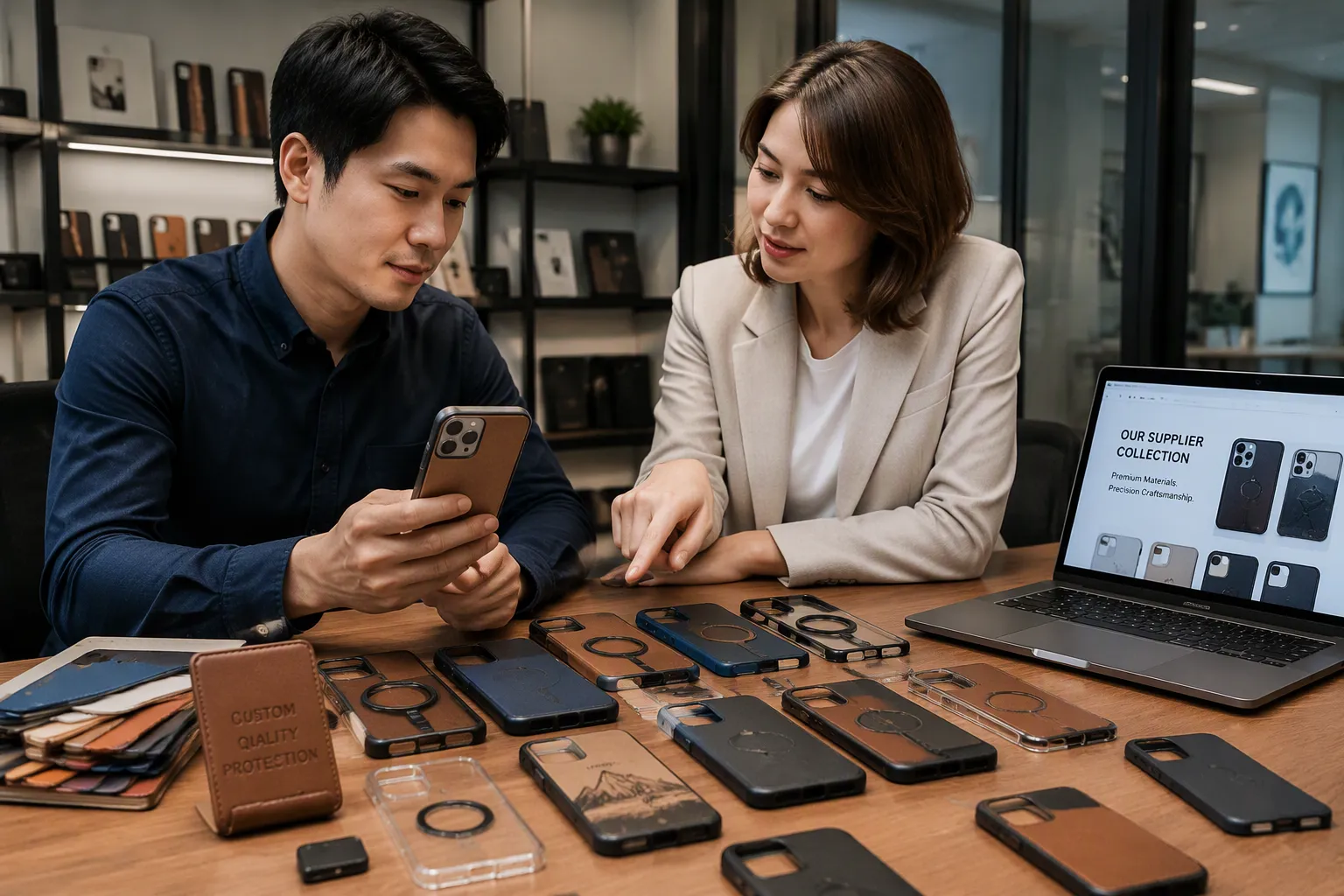
Your mobile protection product line succeeds or fails on one choice: picking a supplier who gives you both top quality and real customization. A supplier who is strong in one area but weak in the other will hold back your product, your profits, and your reputation.
You can handle this risk with a five-step sourcing process. Define your needs, research premium suppliers, check what they can do, confirm quality and compliance, and negotiate costs.
A clear evaluation lowers your risk at every step. It also sets up a lasting supplier partnership instead of a one-time purchase.
Write a clear customization brief before you contact suppliers. This brief states your protection type, materials, design specs, and order volume.
Look for suppliers using directories, trade shows, referrals, and online searches. Try to find five to eight candidates.
Check each supplier's technical skills and how much they can produce. Ask about the materials they use, how they test products, and how they control quality.
Check the certifications and test samples on your own. Make sure the certificates cover your exact product, and audit the factory.
Talk about prices by looking at the full cost of owning the product, not just the price of one unit. Put every term in a written contract.
Write a customization brief before you contact any supplier. This document states your protection type, materials, design requirements, and target order volume. A clear brief gives every supplier the same starting point. It also lets you compare quotes fairly.
Start with the protection category. Cases, screen protectors, and enclosures each need different tooling and testing. Your material choice then shapes cost, feel, and durability. The table below shows common screen protection materials and their key specs.
Material Type | Hardness | Thickness | Key Characteristics |
|---|---|---|---|
PET Film | 4H | 0.15 mm | Rigid plastic film; suitable for flat screens only |
3D Curved PET Film | 4H | 0.15 mm | Hot-bent at high temperature for curved-edge devices |
TPU Film | 4H | 0.15 mm | Soft plastic film; suited for curved-edge devices |
2.5D Tempered Glass | 9H | 0.33 mm (raw glass) | Clear, flat, tough; most popular regular protector |
Tempered glass usually resists scratches better and feels like the original screen. Plastic films stay cheaper and thinner. Match the material to your device range and your price tier.
Next, spell out your design requirements. Include artwork files, colorways, packaging, and any branding elements. Then set your target order volume. This number drives your minimum order quantity (MOQ), the smallest order a supplier will accept. It also affects your lead time, the total duration from order confirmation to delivery.
Plan your timeline with real numbers. Most custom phone case projects require 10–20 days for sample development and approximately 25–40 days for mass production after sample approval.
Phase | Typical Duration |
|---|---|
Sample Development Total | 10–20 days |
Mass Production Total | 25–40 days after sample approval |
Shipping (Express) | 3–7 days |
Shipping (Sea Freight) | 20–45 days |
Most custom phone case projects require 10–20 days for sample development and approximately 25–40 days for mass production after sample approval.
Build these windows into your launch plan. A brief with clear specs and volumes saves weeks of back-and-forth later.
Your brief is ready. Now you need a short list of suppliers who can meet it. Start by learning about the supplier landscape. Different supplier types fit different business models, and each one is a good choice.
White-label programs, such as Allshield, fit carriers, retailers, and OEMs that want ready-made products sold under their own brand.
Custom-cut screen protection, such as ProtectionPro by Madico, fits retailers and repair stores that cut protectors on site for many device models.
End-to-end solution providers, such as Assurant, help businesses that want protection programs bundled with services.
Match the type to your sales channel first. A repair store needs on-demand cutting equipment. A carrier needs a branded program with logistics support. This step narrows your search before you compare individual companies.
Industry directories give you a broad first look. Trade publications, supplier catalogs, and industry association lists name established players in mobile accessories. Filter these lists by product category, region, and certification claims.
Trade shows add something a directory cannot: direct contact. You can handle samples, judge build quality in person, and meet the engineering team behind the product. Collect catalogs and business cards, then log each contact in a simple spreadsheet with notes on fit.
Ask people who already source protection products. Distributors, retail buyers, and repair shop owners can share which premium suppliers delivered on time and which ones struggled with custom work. A referral from a trusted contact often shortens your evaluation.
Online searches fill the gaps. Check supplier websites, product listings, and certification databases. Cross-check every name across all four channels: directories, trade shows, referrals, and search. A supplier that appears in several places earns a spot on your short list. Aim for five to eight candidates before you move to capability evaluation.
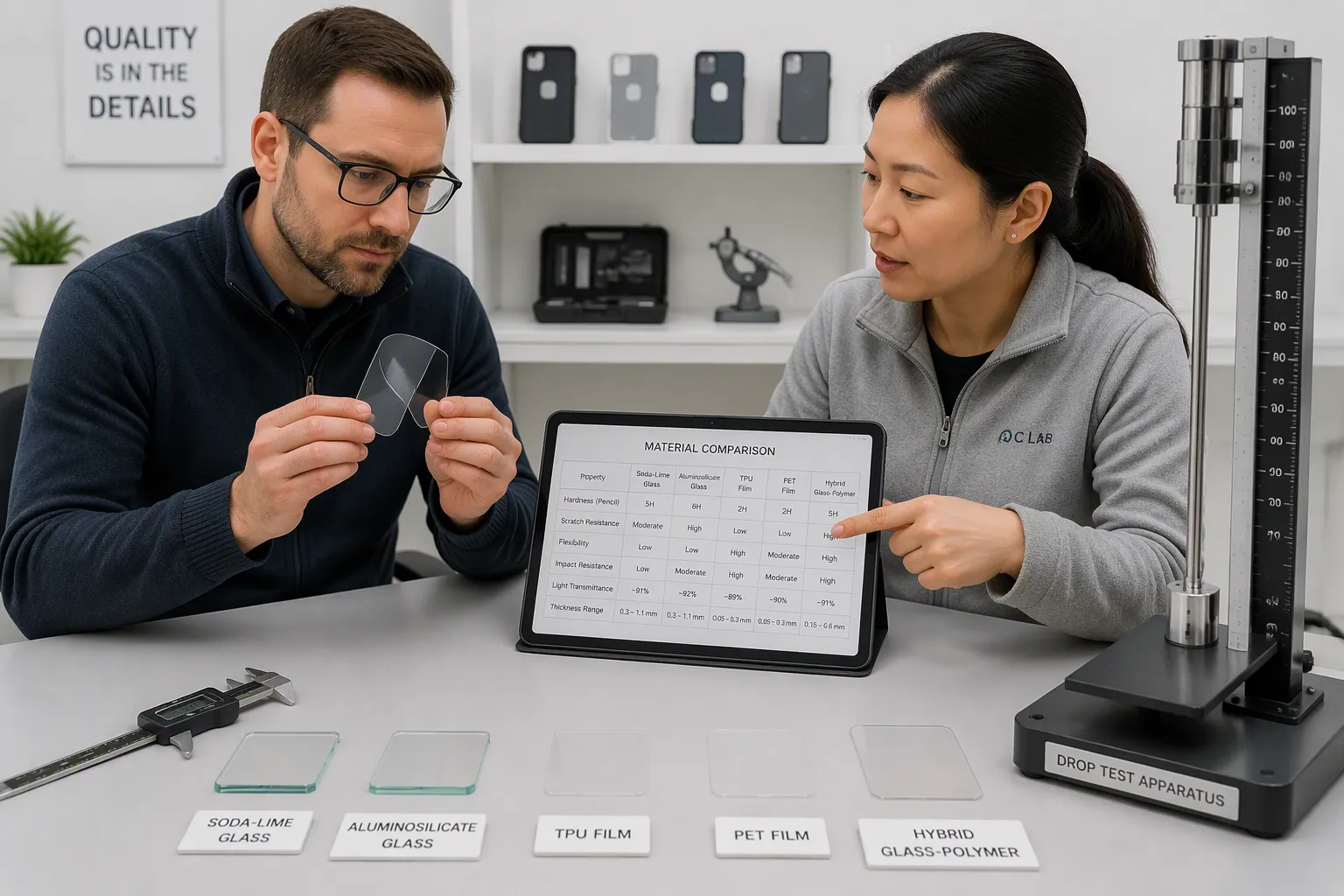
A short list means nothing without proof. Now you test what each candidate can really do. Ask direct questions about materials, engineering, capacity, and quality control. Compare the answers against a known benchmark, not against marketing talk.
Start with material science. Ask which glass the supplier uses and how they temper it. Soda-lime glass is window-grade material with rushed heat treatment. It scratches and cracks easily, and it sits in the $5–10 price tier. Aluminosilicate glass uses the same material as phone screens with proper ion exchange. It is much tougher with better impact resistance, and it costs $25–45. TPU is a flexible plastic that won't shatter and works on curved screens, though it scratches faster, at $15–30. PET film offers minimal protection at $3–8. Hybrid materials combine glass and polymer, beat tempered glass on edge impacts, and land at $30–50.
Hybrid glass/polymer combinations can outperform traditional tempered glass, especially for edge impacts — where rigid glass tends to crack, the flexible polymer absorbs and spreads force. These hybrids combine the clear look of glass with the impact resistance of plastic polymers.
Use X·ONE's standards as your benchmark. Ask whether the supplier offers hybrid polymer impact protection, 6-meter drop protection such as DNA Guard, anti-yellow technology such as EnduraClear™, and AR Pro Coating Technology. Dig deeper into the engineering behind the claims:
Real ion-exchange tempering, where sodium ions swap for larger potassium ions to build inner toughness
Advanced oleophobic coatings that last months or years, not weeks
Silicone-based self-healing adhesives that keep their grip through temperature changes
Ultra-thin flexible glass, around 0.03 mm, with substrate-free adhesive bonding for foldables
Device-specific tooling for precise edge-to-edge coverage, camera cutouts, and curved-edge adhesion
Remember that "tempered glass" and "9H hardness" are not quality standards. Hardness does not equal toughness. Ask about drop-test standards such as MIL-STD-810, which involves repeated impacts from many angles under real-world conditions. Ask about installation engineering too: alignment frames, dust-removal stickers, and forgiving bubble-release adhesives. Their absence signals corner-cutting. Finally, ask how a product fails. Graceful degradation, where spiderweb cracking stays stuck, beats catastrophic shattering.
Capability claims mean little without the capacity to deliver. Ask each candidate about monthly output, scalability for your target volume, and how they handle peak demand. Request their quality-control process in writing. Look for repeated drop tests, touch-sensitivity checks, and adhesion testing under varied conditions. A lifetime replacement guarantee, such as ArmorSuit offers, signals honest confidence in durability. Compare these answers across your shortlist of premium suppliers, and keep the ones who document their processes rather than describe them.
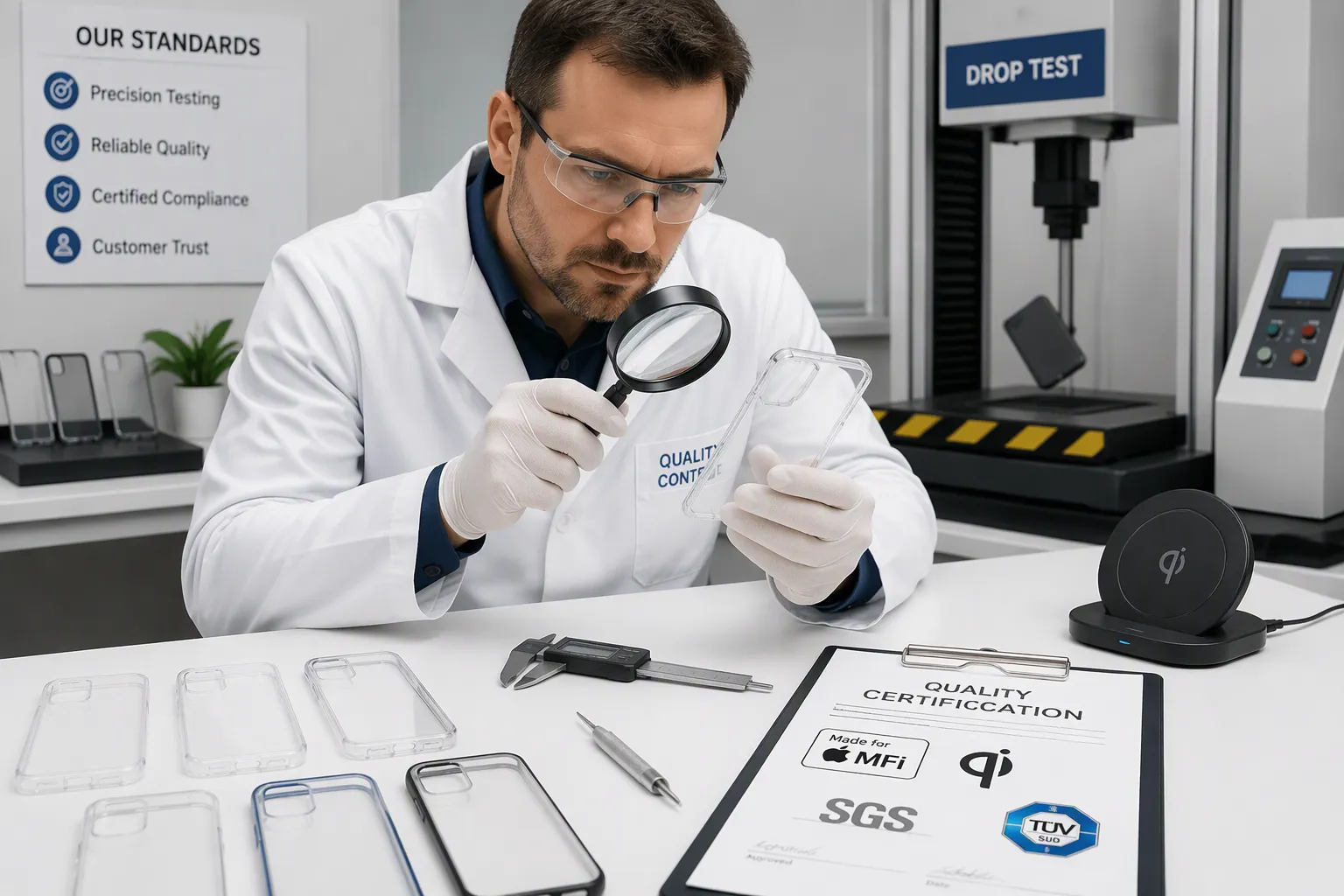
Supplier claims need proof. This step makes sure the premium suppliers on your shortlist really meet the standards they advertise. You check certifications, test samples, and audit facilities before you commit to a bulk order. If you skip this step, the risk lands on your customers.
Certifications give you independent evidence of quality. Ask every candidate which marks they hold, then check each one directly with the issuing body. A logo on a website proves nothing by itself. The table below lists the certifications that matter most for mobile protection products.
Certification / Lab | What It Validates |
|---|---|
Apple MFi | Apple authorization and compatibility for iPhone accessories |
Qi | Wireless charging compliance with WPC standards |
SGS | Independent testing for safety and durability |
TÜV | Independent testing for safety and reliability |
MFi is Apple's proprietary approval path for premium Apple accessories, while Qi2 is the open WPC standard verified by approved labs such as SGS and TÜV. A supplier holding all four marks shows it is a reliable partner.
Use X·ONE's certified product standards as your reference point. X·ONE products carry Apple MFi approval, Qi wireless certification, and testing by SGS and TÜV. A supplier who matches this profile shows you a documented commitment to safety and reliability. Ask for certificate numbers and check their validity dates. Expired certificates signal a supplier who stopped investing in compliance.
Certificates alone do not guarantee a good product. Next, request physical samples. Test each sample against your brief: drop it from height, scratch the surface, check touch sensitivity, and confirm the fit on your target devices. Test more than one unit from the same batch. Consistency across units matters as much as single-unit performance. Compare samples from every candidate side by side, and score them on the same criteria. A sample that fails your tests tells you more than a catalog ever will.
An audit lets you see the factory behind the certificate. Schedule a visit or request a third-party audit report. Walk the production line and watch how workers handle quality checks. Look for written procedures, calibrated test equipment, and recorded inspection results. Ask to see the log from the most recent failed batch and how the team resolved it.
Ask pointed questions during the audit. How does the supplier test drop protection? What happens when a batch fails inspection? Who signs off before shipping? Documented answers separate serious premium suppliers from traders who resell without control. A supplier who cannot explain their own process will struggle to fix problems later.
Confirm that the certification scope covers your specific product. A Qi mark on one model does not extend to every item in the catalog. Check that test reports name your materials and your design. Request updated reports if the supplier changes a component or a production site. Scope gaps are common and easy to miss.
Samples and audits work best together. A sample proves one unit performs well. An audit proves the supplier can repeat that performance across thousands of units. Run both checks before you sign a purchase order. This discipline protects your product quality and your brand reputation.
Price talks come last for a reason. You now know which suppliers can deliver, so you can compare quotes with confidence. Treat unit price as one input, not the deciding number.
A low unit price often hides a high MOQ or a long lead time. Ask each supplier for three numbers together: unit price, minimum order quantity, and delivery window. Then figure out your total cost of ownership. Add tooling fees, sample costs, freight, and the cash tied up in inventory while you wait for delivery. A supplier with a slightly higher unit price but a shorter lead time may cost you less overall, because your stock moves faster and your launch stays on schedule.
Protection programs show how pricing structures differ across the market. Monthly premiums and deductibles change by provider and device tier, so the headline rate rarely tells the full story.
Provider / Source | Monthly Premium (USD/month) | Deductible (USD) |
|---|---|---|
General Market Average | 8 – 14 | Varies |
Verizon Mobile Protect | ~19 | 0 for cracked glass; 99+ for other issues |
AT&T / T-Mobile / Other Carriers | 6 – 19 | Typically 29–149 |
AppleCare+ | ~12 | ~29–75 |
AKKO (3rd-party) | 5 – 15 | US$ 29–US$ 99 |
Read the fine print on fees too. A service fee or deductible often depends on the device model and claim type, and some programs charge a processing fee for certain exchanges. Bundling can lower your rate:
If you buy both the Insurance Device Protection Plan and the Service Contract Device Protection Plan, you'll get a discount of up to $1.50 on the Insurance Device Protection Plan, depending on the device tier.
Use the same thinking for supplier quotes. Ask what each fee covers and where you can combine orders to get a better rate.
Put every agreed term in writing before you place a bulk order. Your contract should list the quality standards from your brief, the delivery schedule with milestone dates, and the remedy if a batch fails inspection. Spell out how you and the supplier will settle disputes, including who pays for return freight on rejected goods. Clear terms protect both sides and remove guesswork when a problem comes up.
You now have a clear, repeatable path from brief to bulk order. Keep this checklist close:
Define what customization you need.
Research premium suppliers.
Evaluate what they can do.
Verify quality and compliance.
Negotiate and manage costs.
Steps three and four matter most. Careful capability assessment and quality checks protect your product quality and your brand reputation. Skipping them moves the risk to your customers.
Treat supplier selection as a lasting partnership, not a one-time deal. Start with the needs-definition step before you contact anyone. A clear brief gives every premium supplier talk a strong foundation.
Try to have five to eight candidates. Check each name across directories, trade shows, referrals, and online searches. A supplier that shows up in several channels earns a spot. This range gives you enough options to compare without making your evaluation too thin.
List your protection type, materials, design files, colorways, packaging, and target order volume. Add your launch timeline. A complete brief gives every supplier the same starting point. It also lets you compare quotes fairly and avoids weeks of back-and-forth later.
No. Check each certificate directly with the issuing body and confirm the scope covers your specific product. Then request samples and test them against your brief. An audit confirms the supplier can repeat that performance across thousands of units.
Ask for unit price, minimum order quantity, and delivery window together. Add tooling fees, sample costs, freight, and inventory carrying costs. A higher unit price with a shorter lead time may cost you less overall. Judge total cost, not the headline rate.
Most custom phone case projects need 10–20 days for sample development. Mass production then takes roughly 25–40 days after sample approval. Add shipping time on top. Build these windows into your launch plan before you contact any supplier.
Join X.ONE to access our best-selling original product,and leverage our end to end technical and marketing support to unlock new growth opportunities for your business.
 Material Support
 Training Support
 Marketing Support
 Exhibition Support
 Technical Support
 After Sales Support