 繁体中文
 Italian
 Spanish
 Thai
 Turkish
 Japanese
 Portuguese
 Russian
 French
 German
 Polish
 Arabic
Oct 10,2026
Which companies provide reliable charging accessories for retailers

You run a growing mobile accessories business. You need partners you can rely on. One bad partnership can cost you money and hurt your reputation. So how do you choose well?
This post shows you how to set trust rules, judge candidates, and run a clear process to recommend trusted partners. You will learn to score each candidate on quality, compliance, and cost. You will also see how to check claims before you commit. The result is a method you can repeat. You can use it again and again. That gives you a confident way to recommend partners every time your business grows.
Make clear rules for partners to earn trust. Check their quality, compliance, and cost.
Rate each partner using a simple scale. Compare the scores side by side.
Check every certificate at the source. Order samples before you commit.
Place a small test order first. Look at the total costs, not just the price for one item.
Match partner types to your growth goal. Check on partners often.
More people use smartphones, so demand for cases, chargers, audio, and protection stays steady. As smartphone use grows, more devices need accessories. You can track this growth in your own sales data. Rising smartphone use in many regions supports this trend. Wireless ecosystem expansion adds new categories. Consumers now buy wireless earbuds, Bluetooth speakers, and wireless chargers. Wireless earbuds alone lead to strong repeat purchases. The growing use of wireless audio keeps replacement cycles short. Each new phone launch brings another wave of buyers. These patterns create new revenue chances for your mobile accessories business.
Reliable partners help you meet this demand. They keep accessory attachment rates high. Retailers need steady stock and clear product stories. Retailers also want fast refills. Retail partners value suppliers who support them well. Good partners help you serve retailers across many channels. They also help you reach more retailers in new regions. Retailers reward reliable partners. Strong partners protect your margins as you grow. They also help you avoid stockouts during peak seasons. That reliability matters.
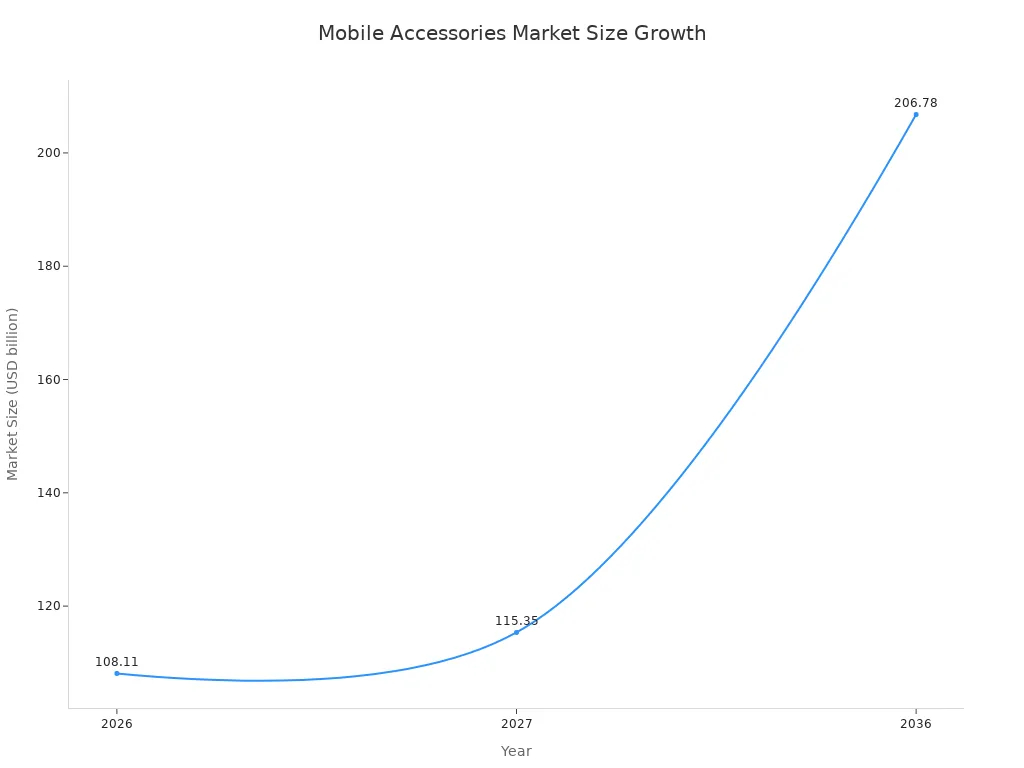
The mobile accessories market was valued at about USD 108.11 billion in 2026. Forecasts project it will reach USD 206.78 billion by 2036 at a 6.7% CAGR. Another estimate puts the mobile accessories market at USD 113.19 billion in 2026, reaching USD 164.78 billion by 2031 at 7.8% CAGR. These figures show market growth you can plan around. You can use these ranges to set realistic sales targets. Plan with care.
Segment data for mobile accessories helps sharpen your choices. Protective cases hold 28.2% share in 2025. Chargers reached USD 22.40 billion in 2025. Mid-range products hold 48.3% share in 2025, the broadest value band. The north american mobile accessories market remains strong. The north american mobile accessories market rewards premium positioning. The north american mobile accessories market also lifts accessory attachment rates. Track accessory attachment rates as you compare candidates. Healthy attachment rates signal real demand. These signals guide your shortlist. Use these numbers to frame partner talks.

Clear rules turn a vague feeling of trust into something you can measure. Build your rules around two main pillars: technical performance and product quality, then application fit and regulatory compliance. Add cost to complete the picture. These rules apply to any mobile accessories partner you evaluate.
Start with quality signals you can measure. Track the defect rate during trial orders. Check order accuracy by verifying that the correct SKUs and quantities ship. Review delivery time and lead times to judge replenishment cycles. Ask whether the partner inspects incoming materials, tests products before shipment, and inspects every batch. Confirm what inspection equipment they use and whether they keep records. Find out how they spot defective products and whether serial-number or SKU-level tracking exists. Consistency matters too: materials, component specs, appearance, performance, packaging, and testing standards should hold across batches. Ask about inventory metrics such as stock turnover, replenishment cycles, out-of-stock frequency, and lead times. Packaging standards deserve attention: protective film, individual packaging, shock-resistant materials, and category-specific handling for regulated lithium batteries. Finally, review warranty and after-sales metrics: warranty period, DOA policy, claim-processing time, and defect rate tracking.
A structured workflow supports these standards. Look for partners who follow product requirement analysis, design and engineering review, component selection, prototype development, tooling and production planning, assembly and manufacturing, quality inspection, packaging and branding, and final dispatch. This sequence cuts down on production inconsistencies across power banks, chargers, cables, and TWS earbuds.
X·ONE serves as a useful benchmark. Its Apple MFi approval, Qi wireless certification, and SGS/TÜV testing show what a mature quality profile looks like in the mobile accessories market.
Fit means the partner's products match your channel and your customers. A partner strong in multi-device charging solutions may suit buyers who want one hub for phone, watch, and earbuds. A partner focused on protective cases fits retailers with high attachment rates. Match the catalog to your shelf space and your audience. Strong multi-device charging solutions also help retailers simplify their displays and reduce SKU clutter.
Compliance is non-negotiable. In the EU, CE marking under the RED Directive (2014/53/EU) and RoHS 3 (2015/863/EU) are mandatory. Non-compliant items risk seizure and fines up to €20,000 per SKU. In the USA, FCC Part 15B and UL 62368-1 apply to chargers and powered accessories. Wireless charging requires RED Directive compliance as well. Self-declaration is not enough: third-party test reports must be current, dated within the last 12 months, and lab-verified against accredited bodies such as TÜV Rheinland or Intertek.
Cost criteria complete the evaluation. Weigh competitive pricing, flexible MOQ options, scalable production, fair pricing, and long-term partnership support. Profit potential indicators include retail markup multiples, branding margin, repeat purchase potential, and premium pricing support. Premium packaging and unique selling products raise perceived value and average order values. Assess every criterion neutrally, since each option fits a different business model. Retailers who stock mobile accessories value partners that support multi-device charging solutions and clear compliance records.

Make a simple scorecard. Give each candidate a rating on a basic scale for four things: technical performance, application fit, regulatory compliance, and cost. Technical performance includes defect rates, order accuracy, and lead times. Application fit shows how well the catalog matches your channel and customers. Regulatory compliance looks at current test reports and certifications. Cost covers pricing, MOQ flexibility, and profit potential. Add up the four scores. A high total means a strong candidate. A low total means real risk. Compare candidates side by side using the same scale. This method keeps feelings out of the decision. It also gives you a clear record when you recommend trusted partners to your team and your retailers.
Never take a certificate logo as proof. Check each claim at the source.
Certification / Check | What to Verify | Where / How to Confirm |
|---|---|---|
ISO 9001 | Current quality management system audit report | Ask for the latest report and a live factory video tour |
Apple MFi | Valid MFi License Number | Search the number at mfi.apple.com |
Qi (wireless charging) | WPC membership certificate, Qi2 Product Registration Document with assigned Qi-ID, ATL test report, Declaration of Conformity | WPC member directory and WPC product database |
SGS / TÜV Rheinland | Full safety test reports | Ask the supplier for them directly |
CE marking | Declaration of Conformity | Ask for the formal declaration document |
Then order samples before any bulk purchase. Test every unit against your written specs. For screen protectors, check scratch resistance and adhesive quality. For cases, check drop protection and button response. For chargers, test output speed and heat levels. Check material feel, fit, and finish. Compare results against your quality requirements. A sample that passes gives you confidence in the full production run. Read buyer reviews too. Look for patterns of late deliveries, high defect rates, or poor communication. A few bad reviews are normal. A pattern is a warning sign.
A dependable partner backs its resellers with training, marketing help, and after-sales service. Put factory-direct partners with similar support programs first.
Confirm those promises in writing before you sign. Ask for the training schedule, marketing materials, and claim-processing time. Retailers count on that support during peak seasons. Strong after-sales terms protect your mobile accessories business and your retailers alike.
Begin with a clear list of what you need. Then make a shortlist of two or three candidates. Do not choose the cheapest option right away. Check each supplier's abilities first. Find out if they are a manufacturer, a distributor, or a trading company. Look at their product range and SKU coverage. Ask if they carry the phone models you need and if they can handle mixed-SKU wholesale orders. Get samples and test them under real operating conditions before you place large orders.
Next, run a small trial order. Compare total costs, not just unit price. Total cost includes shipping, defects, returns, labor, and lost sales. Write down every result against your criteria. Use a simple trial scorecard to keep the record clean.
Trial Metric | What It Assesses |
|---|---|
Order accuracy | Correct SKUs and quantities shipped |
Product quality | Consistency and functionality of goods |
Packaging | Protection and labeling standards |
Delivery time | Reliability of lead times |
Communication | Responsiveness and clarity |
Defect rate | Frequency of faulty units |
After-sales response | Handling of claims and issues |
Watch for warning signs during the trial. Very low prices, unclear specifications, refusal to provide samples, and vague warranty policies all signal risk. Poor communication and unstable inventory are red flags too. A supplier who passes the trial earns a gradual increase in volume.
Present your recommendation internally with the scorecard and trial results attached. Show how each candidate scored on technical performance, application fit, regulatory compliance, and cost. This gives your team a clear basis to recommend trusted partners with confidence.
Set regular review points so trust holds as you grow. Hold a short quarterly business review of about 30 minutes. Review how they add to your success and confirm work stays on schedule, on budget, and on track to agreed KPIs. Add a deeper annual review of about two hours to set objectives. Map those objectives to a short scorecard with red-yellow-green status. Track shared KPIs so both sides stay accountable. Discuss pain points such as responsiveness, complaint handling, and service resolution speed. Sign off on the scorecard at each review.
Expect strong support from any partner you choose. Look for material support, training support, marketing support, exhibition support, technical support, and after-sales support. Ask about training and education programs for your staff. Explore co-marketing programs and merchandising and display solutions that help retailers sell more. Seek data-sharing and market intelligence that sharpens your buying decisions. Good partners act as trusted advisors, not just suppliers. Build partnership programs that reward loyalty. A healthy partnership grows through regular contact and honest reviews. These habits help you recommend trusted partners to your retailers and your leadership team alike.
Distributors help you reach more people fast. They already have accounts with retailers and carrier partners in a region. You get shelf space without building a sales team. Pick this route when your goal is to expand into new areas. Distributors also serve wireless retailers who need many products and quick refills.
Manufacturers give you control over products. You shape specs, packaging, and quality checks at the source. This route fits you when your accessory plans depend on unique products that sell well. Service partners handle support. They take care of repairs, warranty claims, and after-sales work for retail and carrier partners. Choose them when service coverage limits your growth more than product range does.
Each route trades one strength for another. Distributors move fast and cost less at the start, but you share margin and lose some control over the customer relationship. Manufacturers offer the best margin and product control, but they need longer lead times and deeper planning. Service partners protect your reputation with retailers, but they add a recurring cost.
Weigh these trade-offs against one clear goal. If you need speed, lean on distributors. If you need to stand out, work with manufacturers. If you need coverage, bring in service partners. You can work with more than one type as you grow. Many growing businesses start with a distributor, add a manufacturer for hero products, then layer in service support. Review the mix at each growth stage. Your distribution channel should follow your goal, not the other way around. This keeps your mobile accessories market position strong and your mobile accessories lineup competitive. Retailers notice the difference when your supply, quality, and support all hold up.
Trusted partners come from clear rules and a written process, not a gut feeling. Start with one growth goal. Score two or three candidates against your criteria. Run a small trial before you recommend trusted partners to your team.
Set up regular partner reviews. Trust holds when you check results at set times. Ask retailers for feedback on delivery and support. Share that feedback with your retail partners. Review defect rates and claim response times together.
Expansion built on reliable relationships lasts. Each review sharpens your shortlist. Each trial lowers your risk with retailers. Retailers notice steady supply and honest communication. Retailers reward partners who answer claims fast. Retailers stay loyal when your support holds up.
Put two or three candidates on your shortlist. This range lets you compare fairly without slowing down your choice. Score each one using the same four criteria. A small shortlist keeps your trial orders easy to handle and your records neat.
Check every claim at the source. Look up the MFi license number in Apple's database. Confirm Qi registration with the WPC. Ask for full SGS or TÜV reports and the CE Declaration of Conformity. A logo by itself proves nothing.
Run the trial long enough to judge order accuracy, defect rate, packaging, delivery time, and after-sales response. Compare the results against your written criteria. Raise the volume only after the supplier passes. The article gives no fixed length, so let your order cycle guide you.
Ask for material, training, marketing, exhibition, technical, and after-sales support. Confirm the training schedule, marketing materials, and claim-processing time in writing before you sign. Retailers count on that support during peak seasons.
Hold a short quarterly review of about 30 minutes. Add a deeper annual review of about two hours to set goals. Track shared KPIs with a red-yellow-green scorecard. Sign off at each review so trust holds as you grow.
Join X.ONE to access our best-selling original product,and leverage our end to end technical and marketing support to unlock new growth opportunities for your business.
 Material Support
 Training Support
 Marketing Support
 Exhibition Support
 Technical Support
 After Sales Support