 繁体中文
 Italian
 Spanish
 Thai
 Turkish
 Japanese
 Portuguese
 Russian
 French
 German
 Polish
 Arabic

Aug 13,2026
How to choose a professional screen protector supplier for your store

How do you find a company whose after-sales support for accessories really holds up? You need a clear way to judge providers before you commit. This guide gives you that framework: what to look for, how to test a provider's claims, and what dependable service actually delivers.
Accessories wear out. Chargers fail, cases crack, and mounts loosen over time. Weak service turns each of these moments into downtime and added cost. Strong service keeps your devices working and your budget intact.
You deserve reliable after-sales support. The right partner treats after-sales service as a strength, not a gamble. Apply the checklist in this guide before you sign.
Good after-sales support saves you money and keeps your accessories working well.
Before you buy, check the warranty terms and whether parts are available.
Check how fast they respond and read reviews to find trustworthy providers.
Stay away from providers that offer unclear warranties or service channels that are hard to reach.
Use a scoring system to compare vendors and pick the best support.
After-sales support covers everything that happens after you buy: repairs, replacements, maintenance, and technical help. This stage decides whether a product keeps working or turns into a problem. In the heavy machinery and construction sector, plant equipment stays healthy and performs well only with dependable service. Accessories are no different. A failed charger or a cracked case interrupts your day, and weak service turns a small fault into a long delay.
Poor service carries a price you feel over time. Think about how customers react to bad experiences:
70% of customers say they would stop buying from a company after just two bad experiences.
55% have already walked away from a purchase because of poor service.
A support ticket left unresolved for more than 48 hours predicts churn better than a low NPS score.
Lower churn extends customer lifespan, and a longer lifespan directly raises lifetime value.
A customer who has a bad experience with product shipment, for example, may leave the brand a year into spending with them, which lowers their customer lifetime value.
Friction raises churn. Unclear communication and slow response times weaken loyalty, no matter how strong the first sale was. Satisfaction drops when service issues stay unresolved. Teams that track satisfaction signals can step in before the relationship breaks down.
Strong service turns a single purchase into an ongoing relationship. Keeping an existing customer costs far less than getting a new one, and returning customers spend more than new ones. Customers who see steady value become advocates. They also forgive occasional problems and share feedback directly instead of complaining in public.
Reliable after-sales support builds this trust through clear warranties, repair options, and easy returns. Effective after-sales support also includes loyalty rewards and feedback channels. These tools keep buyers engaged and give companies useful insight. This makes after-sales support a key factor in long-term growth. High-quality customer service protects your investment and keeps your equipment running.
You can tell a provider is dependable by the tools and steps it gives you. Look for a self-service portal where you can check warranty status, open a ticket, and track a repair without waiting on hold. Look for clear warranty terms, repair and replacement options, and a loyalty program that rewards repeat business. A customer feedback channel matters too. It shows the provider wants to hear about problems before they grow.
Parts availability is what separates strong providers from weak ones. Reliable after-sales support means dependable access to genuine OEM parts, and that access changes your experience in several ways:
It shortens repair waiting times.
It prevents downtime from a single missing part.
It keeps equipment performance and reliability steady.
It upholds worker safety.
It keeps your warranties valid.
Fast access to spare parts also protects the value of what you bought. A provider that stocks genuine, OEM-compatible spare parts can fix a unit in days instead of weeks. Ask whether the company offers access to OEM-compatible spare parts close to your region. Refurbishment options add another layer. A good partner can restore a worn accessory to working condition through genuine OEM parts, servicing, and refurbishments. That route often costs less than a full replacement.
Effective after-sales support does not wait for a breakdown. Scheduled maintenance keeps equipment at peak performance and makes assets last longer. Regular preventative maintenance checks cost less than reactive repairs, and you can time them during off-peak hours to avoid downtime. Ask how the provider handles scheduled maintenance and refurbishments. A structured plan with fixed intervals beats a vague promise of help.
Prompt emergency responses complete the picture. When an urgent issue hits, a fast reaction cuts on-site downtime. The best providers give you a clear, structured service path with zero guesswork. You know who to call, what happens next, and when the fix arrives.
Follow-up communication is another hallmark. A dependable partner checks back after a repair to confirm the fix held. Clear return processes matter just as much. Customer-friendly return policies tell you exactly how to send an item back, who pays shipping, and how long a refund or exchange takes. These details turn after-sales support from a promise into a system you can rely on. Weigh each element when you compare providers, and you will separate real support from marketing language.
You can judge a provider before you spend any money. Evaluation takes two steps. Ask the right questions up front, then measure what the provider really delivers. A little homework now saves you months of frustration later.
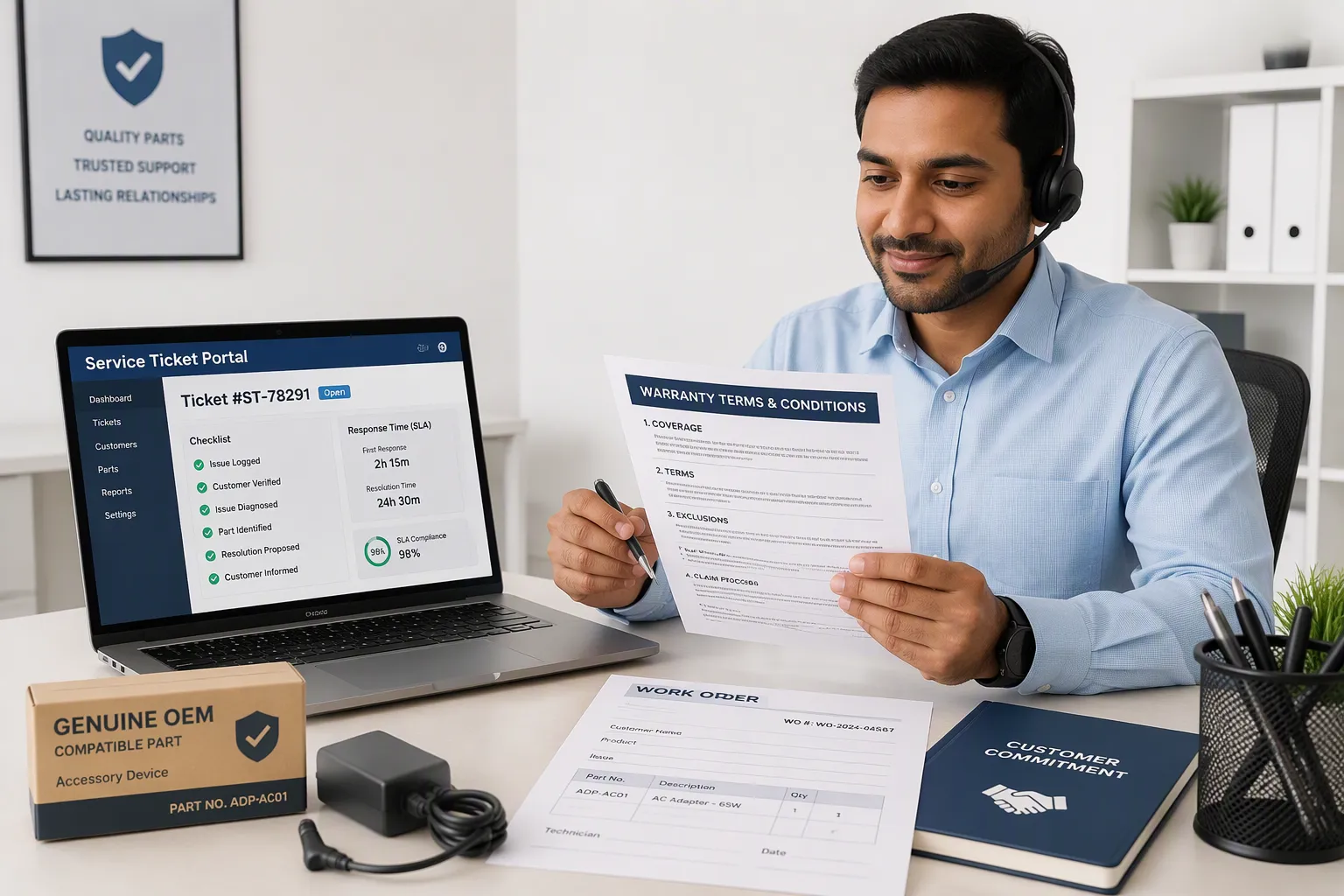
Start with warranty terms. Ask what the coverage period is, which parts and labor it includes, and what exclusions apply. Make clear who pays for shipping, diagnostics, and replacement units. Request every term in writing. A verbal promise means little when a claim arrives.
Then ask about parts. Confirm the provider stocks genuine, OEM-compatible spare parts and can name a delivery date. Ask how the company handles scheduled maintenance and whether it offers refurbishment. Record the supplier and part number on your work order. That habit protects your coverage if a repeat failure occurs. Ask for the total installed cost, not just the unit price. Confirm fitment for your exact device model. Check whether the provider reviews repeat failures by part number. A supplier that tracks its own failure data knows where its weak points sit.
Map the service channels next. Can you open a ticket by phone, email, or a self-service portal? Who answers, and how fast? Ask whether one visit can trigger more than one deductible on a service contract. Ask for written return terms too. You want to know who pays return shipping and how long an exchange takes.
Keep one more factor in mind. OEM after-sales service often struggles with scale, distance, flexibility, and cost. Large field teams carry heavy overhead. Remote customers wait longer for a visit. Suppliers that provide effective after-sales support solve these problems through regional stock, local partners, and clear escalation paths. Ask how a provider covers your region.
Once you buy, track the numbers. A few metrics reveal whether the service holds up:
Metric | What it tells you |
|---|---|
How quickly an agent replies | |
Average resolution time | How long a full fix takes |
How many issues sit unresolved | |
Self-service rate | How many questions the portal answers alone |
First call resolution rate | How often one contact solves the problem |
Watch response times and availability of spare parts together. Fast response times mean little if the part takes weeks to arrive. Send a short survey after each service visit. A transactional Net Promoter Score survey tied to one interaction shows whether that case helped or hurt your view of the company. Run the same survey across sales, product use, and service touchpoints. Track customer retention rates over a year. Rising retention points to steady reliability.
Judge responsiveness by the first reply, not the final fix alone. A provider with high-quality customer service answers fast and explains the next step. Ask for these figures before you sign. A company that measures its own performance is more likely to improve it.
Warning signs show up before you sign a contract. You just need to know where to look. Two areas show the most: warranty language and service access.
Unclear warranty wording is a common contract mistake. It sits next to missing guarantee terms and undefined claim steps. Weak after-sales support often hides behind this fog. Watch for six gaps in the text:
No start date — you cannot tell when the one-year period begins.
No notice procedure — you get no guidance on how or when to file a claim.
No response time for repair — the seller faces no deadline to fix a defect.
No remedies defined — replacement, refund, or repair stays unclear.
No exclusions — misuse damage looks the same as a manufacturing defect.
No disclaimer of implied warranties — UCC § 2-314 and § 2-315 protections may still apply.
Vague warranty terms such as "satisfactory quality" and "reasonable performance" create disputes over what they mean. They signal weak support because they lack specific, measurable standards.
Read every clause with a pen in hand. Ask the provider to define each term in writing. A company that answers clearly shows real commitment to after-sales service.
Limited contact options are another red flag. A provider that offers only a web form and no phone line slows every urgent fix. Check whether you can reach a person by phone, email, or a self-service portal. Test the channel before you buy. Send one question and time the reply.
Customer reviews and community threads on Reddit and Quora reveal real patterns. Search for the provider's name plus "warranty claim" or "repair." Look for repeated complaints about silence or slow fixes. One angry post means little. A cluster of similar stories points to a system problem. Weigh these signals against the provider type. Large OEMs may trade flexibility for scale, while smaller partners may offer faster personal contact. Match the channel style to your needs, and check brand reputation through these public discussions. Strong reliability shows up in consistent feedback across many sources.
Good service pays you back in ways you can measure. A partner with strong customer service and support keeps your accessories working, and that steady performance shows up in your profits.
Dependable after-sales support makes repair cycles shorter. Quick access to parts and scheduled maintenance help you cut downtime across all your devices. Every hour a charger or mount stays broken costs you productivity. A provider that stocks genuine parts and responds fast reduces that loss.
Total cost of ownership drops too. You avoid emergency replacements, rush shipping fees, and repeat repairs on the same problem. Effective after-sales support turns these costs into planned, predictable expenses. Brands known for strong service, including how they handle price questions, are more likely to deliver dependable after-sales support for accessories. They treat service as part of the product, not an extra.
Honest communication builds trust over time. Think of a 3PL owner who faced a client's pricing challenge. He shared a full cost breakdown and revealed his actual 8% margin against an industry average of 12–15%. He then asked the client what he would do in his position. The talk shifted from haggling to teamwork. The two sides kept pricing flat in exchange for higher volume, and a year later the client stayed with volume up 40%.
That story holds lessons for your vendor search:
Treat negotiation as one move in a longer game, not a battle to win.
Handle pricing terms and disputes in a professional way and without delay.
Build relationship management, not just administration, to unlock better pricing and priority supply during shortages.
Build transparency and respect during negotiations.
Clear customer service policies and honest answers show a partner worth keeping. AGGPRO proves this in practice. The company offers nationwide parts supply, support coverage for machinery across Great Britain, a new parts depot in the south, and highly skilled support engineers. These are the after-sales habits that protect your operations. Strong after-sales service and high-quality customer service both start with the same base: a partner that plans for problems before they arrive.
AGGPRO shows how strong partner support works in real life. The company supplies parts nationwide and covers machinery across Great Britain. It also opened a new parts depot in the south and has highly skilled support engineers. These habits keep equipment running and cut downtime for buyers.
X·ONE offers another good model. The brand started in 2009 and now reaches more than 60 countries. It has sold over 100 million units and holds 180+ patents. It also carries Apple MFi, Qi, SGS, and TÜV certifications. Partners get help with materials, training, marketing, exhibitions, technical questions, and after-sales support. That mix covers the whole life of a product, from the first sale to repair. Treat these firms as examples, not the only path. Large OEMs fit buyers who need scale and global reach. Smaller regional partners often fit buyers who value fast, personal contact.
Use a weighted scoring framework to compare vendors in a fair way. The table below shows typical weights for each factor.
Evaluation Factor | Typical Weight | Key Considerations |
|---|---|---|
Security and Compliance | 25-35% | Certifications, encryption, regulatory track record, incident response |
Technical Capability and Integration | 20-30% | API quality, stack integration, scalability, innovation roadmap |
Cost and Financial Considerations | 15-25% | TCO, pricing transparency, hidden costs, ROI potential |
Vendor Stability and Reputation | 10-20% | Financial health, retention rates, reputation, references |
Support and Service Quality | 10-15% | SLA guarantees, support responsiveness, training, account management |
A few habits set good vendor programs apart from weak ones. Standardize contracts and track performance through consistent KPIs. Run careful onboarding and hold regular business reviews. Treat vendors as strategic partners, not interchangeable order-takers. Match your vendor pool to your volume and the resilience you need. A centralized program also helps. Without one, teams pick vendors by habit instead of performance data. Four KPIs best predict supplier quality: response rate, hit rate, cost tolerance, and falloff or turnover rate. Apply these checks before you sign, and your after-sales support will rest on evidence rather than hope.
Good after-sales support pays you back. You avoid downtime, keep total cost under control, and keep your accessories working. That payoff makes after-sales support a smart investment, not just an expense.
Bring five checks into your vendor search: access to genuine parts, scheduled maintenance, fast responses, service metrics you can measure, and honest review signals. Effective after-sales support shows up in all five.
Use this checklist before you sign any agreement. Ask the hard questions, time the first reply, and read the warranty line by line. Your after-sales experience starts with the contract you sign today. Choose support you can verify.
Read every clause and ask for the terms in writing. Confirm the coverage period, the included parts and labor, and the exclusions. Ask who pays for shipping and diagnostics. A provider that defines each term clearly shows real commitment to after-sales service.
Ask the provider to name a delivery date for the exact part you need. Request the supplier and part number on your work order. That record protects your coverage if the same part fails again. A provider with regional stock usually fixes a unit faster.
Track the first reply, not just the final fix. A ticket left unresolved for more than 48 hours predicts churn better than a low NPS score. Time one question before you buy. Fast answers plus available parts signal dependable after-sales support.
Yes, when you read them the right way. Search the provider's name plus "warranty claim" or "repair" on Reddit and Quora. One angry post means little. A cluster of similar complaints points to a system problem. Consistent feedback across many sources shows strong support.
Join X.ONE to access our best-selling original product,and leverage our end to end technical and marketing support to unlock new growth opportunities for your business.
 Material Support
 Training Support
 Marketing Support
 Exhibition Support
 Technical Support
 After Sales Support